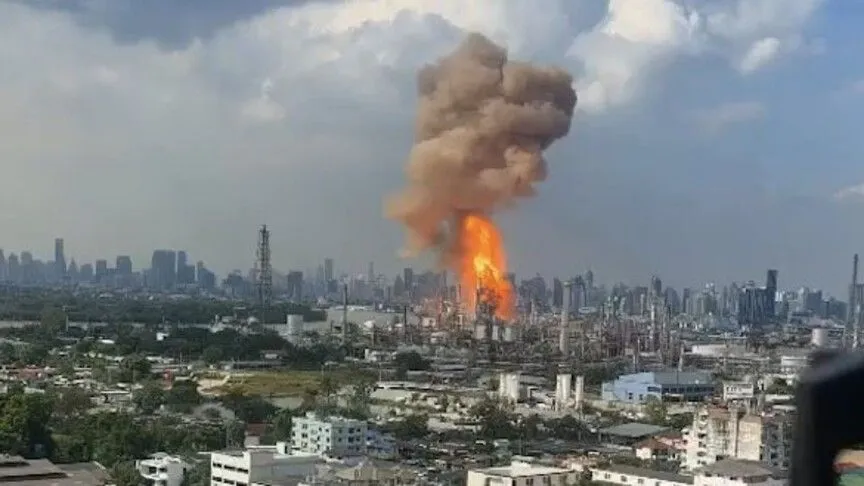
A massive explosion at an oil refinery in eastern Bangkok, Thailand, has raised fresh concerns about industrial safety after flames and thick black smoke filled the sky, forcing authorities to evacuate nearby communities.
The explosion occurred on Thursday, November 26, 2026, at a facility operated by Bangchak Corporation in the Phra Khanong district. The incident triggered an emergency response involving firefighters, rescue workers and local authorities, while residents and students in nearby areas were advised to move away from the facility.
At least nine people were injured, including three who were reported to be in critical condition. The injured were receiving medical attention as authorities began investigating what caused the explosion.
Although firefighters brought the blaze under control within approximately 30 minutes, the incident has raised questions about the risks of operating a major oil refinery within an urban environment.
The facility is not an isolated industrial site surrounded by empty land. It sits in an area with residential communities, schools and businesses. That proximity made the emergency particularly concerning.
Beyond the dramatic images of the explosion, the bigger story is about how prepared industrial operators and city authorities are to protect people when accidents happen at facilities handling large quantities of petroleum products.
What Happened at the Bangchak Oil Refinery?
The explosion happened at approximately 2:45 p.m. local time on Thursday, November 26, at Bangchak Corporation’s Phra Khanong refinery along Sukhumvit Soi 62.
Videos shared on social media showed enormous flames rising above the industrial complex, followed by thick black smoke spreading across parts of eastern Bangkok.
The force of the explosion was reportedly strong enough to shake doors several kilometres away from the facility.
Bang Na District Office quickly issued an emergency warning, advising people living and working around the refinery to evacuate for their safety.
Firefighters and emergency response teams were dispatched to the location as authorities attempted to prevent the fire from spreading to other parts of the facility.
Bangchak Corporation subsequently confirmed that the situation had been brought under control. The company said the fire was extinguished at approximately 3:15 p.m., around 30 minutes after it started.
However, the incident had already caused injuries and disrupted activities around the facility.
Nearby schools and residents were among those affected by the precautionary evacuation measures.
Nine People Injured as Authorities Investigate the Explosion
The human consequences of the Bangkok oil refinery explosion quickly became clearer as emergency medical authorities released updated information.
Bangkok’s Erawan Emergency Medical Centre initially reported seven injured people, including four classified as critical cases and three with less serious injuries.
Later reports from Bangchak Corporation put the total number of injured personnel at nine.
The company also confirmed that two of the injured had returned home following medical attention.
The difference between the initial medical figures and the company’s later update shows why casualty figures during major emergencies should be treated carefully until authorities complete their assessments.
Fortunately, the fire did not develop into a larger disaster involving the refinery’s oil and gas storage tanks.
Thailand’s Energy Minister, Akanat Promphan, visited the site following the explosion and said preliminary information indicated that the fire had started in a processing area rather than the main storage facilities.
He also explained that the affected section was separated from the oil storage tanks, helping to limit the potential scale of the incident.
The authorities will still need to establish the full extent of the damage and determine whether any equipment failures or operational problems contributed to the explosion.
Why Was an Oil Refinery Operating So Close to Residential Areas?
Perhaps the most important issue raised by the incident is the location of the Bangchak refinery.
The Phra Khanong facility is an established industrial complex in eastern Bangkok, an area that has developed considerably over the years.
Unlike many large refineries located far from major population centres, this facility operates within an urban environment.
According to reports, it has a maximum processing capacity of approximately 120,000 barrels of oil per day. It is also described as Thailand’s fifth-largest refinery and the country’s only urban refinery.
That makes its location particularly significant.
Industrial facilities that process petroleum products carry risks that extend beyond their immediate boundaries. Equipment failures, fires, explosions and chemical releases can affect workers, nearby businesses and entire communities.
When such facilities are located close to residential neighbourhoods, emergency planning becomes even more important.
Authorities must consider how quickly residents can be evacuated, whether emergency vehicles can access the area and how smoke or potentially harmful substances could affect surrounding communities.
The Bangkok explosion demonstrates why industrial safety cannot be treated as an internal company responsibility alone.
Even when a fire is contained within a facility, the people living outside its gates may still face serious risks.
In my opinion, Thailand should use this incident as an opportunity to review emergency arrangements around major industrial facilities, particularly those operating close to densely populated areas.
Refinery Shuts Down Production as Safety Checks Begin
Following the explosion, Bangchak Corporation announced that it had suspended production across all units at its Phra Khanong refinery.
The decision was taken as a precaution while investigators examined the affected equipment and assessed the safety of the wider facility.
Preliminary reports identified the hydrocracking unit as the area involved in the incident. This is an important part of the refining process, where heavier petroleum fractions are converted into more valuable fuel products using hydrogen, heat and pressure.
The shutdown is significant because the refinery has a maximum processing capacity of 120,000 barrels daily.
However, the suspension does not automatically mean Thailand is facing an immediate fuel shortage.
Energy Minister Akanat said the country’s overall oil supply should remain stable because Thailand has several other refineries capable of supporting domestic demand.
Bangchak also operates another refinery, giving the company additional refining capacity outside the affected Phra Khanong facility.
Nevertheless, the longer the shutdown continues, the more important it becomes for authorities and the company to assess its effect on production and distribution.
The government has indicated that operations should not resume until the necessary safety checks have been completed.
That is a reasonable position. Restarting production before understanding what caused the explosion could expose workers and nearby residents to another emergency.
Did the Explosion Cause Dangerous Air Pollution?
Another major concern following the incident was the thick black smoke that spread above Bangkok.
Smoke from industrial fires can contain substances that irritate the eyes and respiratory system. Depending on the materials involved, exposure may also present more serious health risks.
This explains why authorities treated the incident as a public safety emergency even after the flames were brought under control.
The Pollution Control Department conducted air quality measurements around the refinery, including checks for carbon monoxide, sulphur dioxide and other pollutants.
Initial measurements reported by authorities were within normal limits. Benzene readings were also reported below the emergency exposure guideline used for comparison.
Residents who had evacuated were subsequently allowed to return home.
However, officials said monitoring would continue, particularly around nearby residential communities and schools.
Authorities also considered the possibility of environmental contamination through water used to extinguish the fire.
This is important because industrial fires can create environmental problems even after the visible flames disappear.
The government therefore needs to establish whether the incident affected nearby waterways, drainage systems or surrounding land.
The initial air quality results are encouraging, but continued monitoring is necessary to ensure that residents are not exposed to delayed environmental effects.
What Happens Next for Bangchak Corporation?
The immediate priority for Bangchak Corporation is to establish exactly what happened and determine whether equipment failure, maintenance issues or another operational problem contributed to the explosion.
The company will also have to assess the damage before deciding when production can safely resume.
There is an important historical consideration here. The Phra Khanong facility experienced another significant fire in 2012, which reportedly damaged nearby homes and required approximately two weeks of repairs.
That history makes the latest incident particularly important.
Although the two incidents should not automatically be treated as having the same cause, repeated industrial emergencies at a facility close to residential communities deserve serious attention.
Investigators will need to examine the affected equipment, maintenance records, safety procedures and emergency response arrangements.
The findings should also be made available to the public. Residents living near the refinery have a legitimate interest in understanding the risks surrounding their homes.
Bangchak Corporation’s response will therefore be judged not only by how quickly it extinguished the fire, but also by how transparently it handles the investigation and prevents another incident.
Bangkok’s Explosion Is a Warning for Industrial Cities
The Bangkok oil refinery explosion is a reminder that industrial accidents rarely affect only the companies involved.
A single equipment failure can disrupt nearby schools, force families out of their homes, injure workers and create environmental concerns for an entire neighbourhood.
The fact that firefighters contained the blaze within approximately 30 minutes is encouraging. The decision to suspend production and conduct safety checks is also necessary.
However, the incident should not end with a statement that the situation is under control.
Authorities must establish the cause, assess the environmental impact and ensure that the refinery meets the necessary safety standards before operations resume.
For Bangchak Corporation, restoring production will be important. But rebuilding confidence among workers and nearby residents should be equally important.
The explosion could have resulted in a much larger disaster if the fire had reached the facility’s oil storage tanks.
That possibility alone should be enough to encourage a serious review of industrial safety arrangements.
Bangkok has managed to avoid a potentially worse outcome this time. The next challenge is ensuring that another explosion does not put the same communities at risk.