








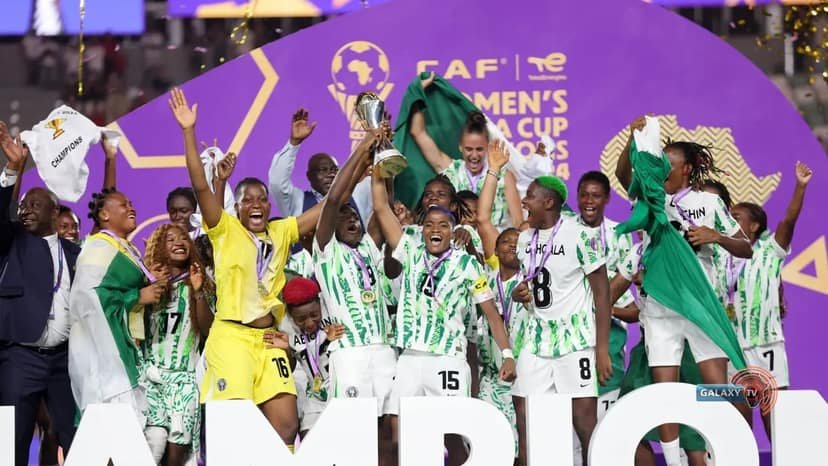
Nigeria’s Super Falcons have finally received the cash rewards promised by President Bola Tinubu after their historic victory at the 2025 Women’s Africa Cup of Nations (WAFCON).
Each of the 24 players is receiving the naira equivalent of $100,000, estimated at approximately ₦140 million per player, while members of the coaching and technical crew are receiving $50,000 each.
The National Sports Commission (NSC) confirmed the payments on November 2, 2026, describing them as the fulfilment of the President’s commitment to recognise the team’s achievement.
Although the announcement has been welcomed by football supporters, the development raises a bigger question about how Nigeria treats its sporting heroes: should athletes have to wait more than a year to receive rewards promised after representing their country?
The Super Falcons had already received three-bedroom apartments in Abuja and national honours. The latest payment completes the cash component of the reward package announced after their dramatic victory over Morocco in July 2025.
More than a year after one of Nigeria’s greatest football achievements, the story is no longer just about a financial reward. It is also about government promises, athlete welfare and the importance of building trust in Nigerian sports.
How the Super Falcons Earned the $100,000 Reward
The reward dates back to July 26, 2025, when Nigeria defeated Morocco 3-2 in the WAFCON final in Rabat to win its 10th continental title.
It was a remarkable victory, particularly because Nigeria had looked close to losing the final after conceding twice in the first half.
Morocco’s Ghizlane Chebbak opened the scoring in the 13th minute, while Sanaa Mssoudy doubled the hosts’ advantage in the 24th minute. With the home supporters celebrating and Nigeria struggling to find a response, the match appeared to be slipping away from the Super Falcons.
However, the second half produced one of the most memorable comebacks in African women’s football.
Esther Okoronkwo converted a penalty in the 64th minute to reduce the deficit. Seven minutes later, she provided the assist for Folashade Ijamilusi to equalise.
Then came the decisive moment. Substitute Jennifer Echegini scored in the 88th minute to complete the turnaround and give Nigeria a 3-2 victory.
The result secured Nigeria’s 10th WAFCON championship, extending its record as the most successful country in the competition.
It was also a particularly important victory because Nigeria had lost to Morocco in the semi-finals of the previous tournament.
The Super Falcons had reclaimed their position at the top of African women’s football, and the Federal Government responded with an impressive reward package.
What Exactly Did Tinubu Promise the Players?
Following their victory, President Tinubu hosted the team at the Presidential Villa in Abuja on July 28, 2025.
During the reception, he announced financial rewards, housing benefits and national honours for the players and technical crew.
The package included:
- 24 Super Falcons players: $100,000 each in naira equivalent.
- Coaches and technical officials: $50,000 each in naira equivalent.
- Housing: Three-bedroom apartments in Abuja for the players and technical crew.
- National honours: Officer of the Order of the Niger (OON) awards.
The financial commitment was significant. At the approximately ₦1,400 exchange rate reflected in the latest payment reports, each player’s $100,000 reward amounts to about ₦140 million.
For the 24 players alone, that represents approximately ₦3.36 billion.
However, the cash payment was not the only part of the promise. The players had also been waiting for the housing arrangements and national recognition to be completed.
According to the National Sports Commission, the players had already received their apartment title documents and OON certificates before the latest cash payment.
The November announcement therefore represents the completion of the major reward package promised after the tournament.
Why Did the Players Have to Wait 15 Months?
This is perhaps the most interesting part of the development.
The President announced the rewards on July 28, 2025. The cash component was confirmed in November 2026, approximately 15 months later.
Although the government has now fulfilled the commitment, the delay raises legitimate questions about how financial promises to Nigerian athletes are processed.
Winning an international competition requires more than talent. Players sacrifice time with their families, manage injuries, travel extensively and face enormous pressure to represent their country successfully.
When the government announces a reward after such an achievement, athletes naturally expect the commitment to be honoured within a reasonable period.
A delay of more than a year does not necessarily mean the promise was abandoned, but it highlights a weakness in how sporting rewards are administered.
In my opinion, the government deserves recognition for eventually delivering the promised money. However, the process should have been faster.
A reward announced immediately after a victory carries emotional and financial significance. Delivering it much later can reduce the excitement surrounding the original achievement.
More importantly, athletes should not have to depend on repeated public announcements or media attention before receiving money officially promised to them.
The bigger achievement would be creating a system where these payments are processed automatically once the necessary approvals are completed.
How Much Money Will Each Super Falcons Player Receive?
According to reports from the National Sports Commission, each player is receiving approximately ₦140 million.
This is the naira equivalent of the $100,000 promised by Tinubu.
The amount is particularly significant considering the financial challenges facing many Nigerian athletes.
However, it is important to understand that the naira equivalent is based on the applicable exchange rate used for the payment. It should not be confused with a fixed naira reward announced in 2025.
The coaching and technical officials are receiving the equivalent of $50,000 each.
The National Sports Commission did not present the latest announcement as a new bonus. Rather, it described the payment as the fulfilment of the original presidential commitment.
Team captain Rasheedat Ajibade also expressed appreciation to the President, describing the gesture as recognition of the team’s achievement and contribution to Nigerian sports.
D’Tigress Also Received the Same Presidential Reward
The Super Falcons are not the only Nigerian women’s national team to benefit from Tinubu’s reward arrangement.
Nigeria’s women’s basketball team, D’Tigress, also received a similar financial package following its victory at the 2025 FIBA Women’s AfroBasket.
D’Tigress defeated Mali 78-64 in the final on August 3, 2025, to secure its fifth consecutive AfroBasket championship and seventh overall.
The President subsequently promised each player $100,000, alongside three-bedroom apartments and national honours. Members of the technical crew were also promised financial rewards.
The National Sports Commission confirmed in September 2026 that D’Tigress had received the cash component, with players getting the naira equivalent of $100,000 and officials receiving $50,000 each.
The completion of both reward packages is encouraging because it suggests that the government is extending financial recognition beyond men’s football.
Women’s sports have historically struggled with unequal attention, commercial opportunities and financial support.
Recognising the achievements of the Super Falcons and D’Tigress is therefore important. These teams have consistently delivered continental success, and their contributions deserve more than occasional celebrations.
However, financial rewards should be part of a larger commitment to improving facilities, training conditions, international exposure and professional opportunities for female athletes.
Is Nigeria Doing Enough for Its Sporting Heroes?
The Super Falcons’ latest payment is good news, but it also presents an opportunity to examine Nigeria’s wider approach to sports development.
Nigeria has a long history of producing exceptional athletes across football, athletics, basketball, wrestling and other sports.
Yet, many athletes face challenges involving unpaid allowances, inadequate facilities, poor preparation and uncertainty about their future after retirement.
These problems cannot be solved by presidential bonuses alone.
For example, the $100,000 reward is substantial, but it does not automatically improve the training environment for the next generation of female footballers.
Young players still need quality academies, professional leagues, reliable coaching, medical support and opportunities to compete internationally.
There is also the question of what happens after an athlete’s playing career ends. Nigeria needs stronger retirement planning, healthcare arrangements and career transition programmes for its sporting professionals.
The government should see the Super Falcons’ achievement as an opportunity to invest in the entire women’s football system rather than simply reward the players who won one tournament.
A stronger domestic league, better sponsorship arrangements and improved youth development could help Nigeria maintain its position as Africa’s leading women’s football nation.
What Happens Next for the Super Falcons?
With the cash reward now being delivered, attention should return to the team’s future performances and preparations for upcoming international competitions.
Nigeria has a record 10 WAFCON titles to defend, but the competition is becoming increasingly difficult.
Morocco, South Africa and other African nations are investing in women’s football and improving their competitiveness.
Morocco’s performance in the 2025 final demonstrated that the gap between Nigeria and its continental rivals is becoming smaller.
The Super Falcons cannot rely on their history alone. They need consistent investment, quality preparation and opportunities for their players to compete at the highest level.
The government also has an opportunity to use the team’s popularity to attract private investors and sponsors into women’s football.
That would create a more sustainable system in which athletes are rewarded not only when they win trophies but also through better professional opportunities throughout their careers.
Ultimately, paying the promised $100,000 is a welcome development. But the real test of Nigeria’s commitment to its sporting heroes will be whether the country can provide an environment where future champions do not have to struggle for the recognition and support they deserve.