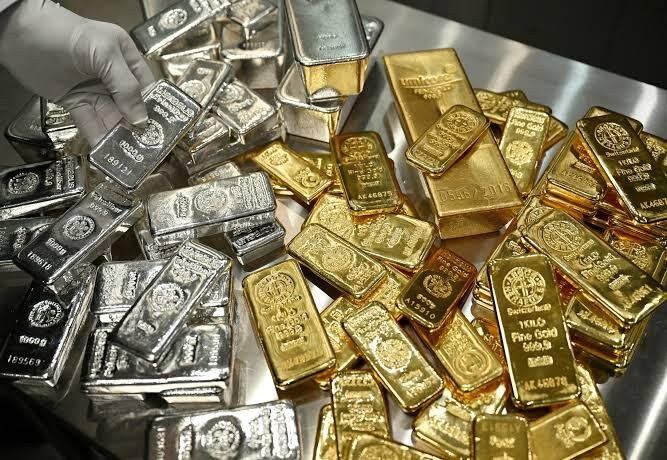
Gold and silver prices have come under renewed pressure after hotter-than-expected US inflation figures changed investors’ expectations about the Federal Reserve’s next interest rate decision. The sell-off has raised fresh questions about whether precious metals can maintain their strong performance when borrowing costs and the US dollar are rising.
On Tuesday, November 10, 2026, spot gold dropped approximately 2.6% to around $4,031.80 per ounce, while silver fell 3.55% to approximately $51.41. The declines followed the release of October’s US Consumer Price Index (CPI), which showed that inflation was rising faster than economists had predicted.
The pressure continued on Wednesday. Gold fell another 1.1% to $3,986.79 per ounce, while investors continued adjusting their positions ahead of the Federal Reserve’s December meeting. By Thursday, November 12, gold had fallen further to $3,948.82, marking its third consecutive daily decline. Silver also slipped to approximately $51.16.
What makes this development particularly interesting is that gold is traditionally viewed as a safe-haven asset during economic uncertainty. However, the latest market reaction demonstrates that investors do not always move towards gold when inflation becomes a concern. Sometimes, the expectation of higher interest rates can make holding precious metals less attractive.
What Did the US Inflation Report Reveal?
The immediate trigger for the gold and silver price crash was the October US inflation report released on November 10.
According to the US Bureau of Labor Statistics, the Consumer Price Index increased by 0.4% in October, compared with economists’ expectations of 0.3%. This followed a 0.6% increase in September.
Core inflation, which excludes food and energy prices because they tend to fluctuate more frequently, also increased by 0.3%. Economists had expected a smaller increase of 0.2%.
Although the difference might appear small, financial markets pay close attention to these figures because they influence expectations about the Federal Reserve’s monetary policy.
The latest numbers suggest that inflationary pressure has not disappeared as quickly as investors would like. Higher costs across areas such as housing, food, energy and services also suggest that the problem is not limited to one part of the economy.
There is an additional complication. The US government shutdown in October 2025 disrupted the collection of comparable inflation data, meaning the latest report did not provide the usual year-on-year October inflation figures. This makes the monthly changes particularly important when assessing the latest trend.
For investors, the important message is that the Federal Reserve may not have enough evidence to begin easing monetary policy as quickly as some had hoped.
Why Are Higher Interest Rates Bad for Gold and Silver?
To understand the sell-off, it is necessary to understand how precious metals compete with interest-bearing investments.
Gold does not pay interest or dividends. Investors make money when its market price increases or when they sell it at a higher value than they purchased it.
When interest rates are low, holding gold becomes relatively attractive because investors earn less from keeping their money in savings accounts and government bonds.
However, when interest rates rise, the situation changes.
Government bonds and other interest-bearing investments can offer better returns, making gold less attractive by comparison. Investors may decide to move some of their money away from precious metals and towards assets that provide regular income.
This is known as the opportunity cost of holding gold.
The stronger dollar adds another problem. Gold and silver are priced internationally in US dollars. When the dollar strengthens, these metals become more expensive for buyers using other currencies.
That can reduce international demand and add further selling pressure.
This is exactly what happened after the October inflation report. The dollar strengthened, Treasury yields climbed and investors increased their expectations of another Federal Reserve rate increase.
The combination created an unfavourable environment for gold and silver.
Federal Reserve Rate Hike Fears Are Driving the Market
The biggest concern for precious metals investors is no longer just the inflation figure itself. It is what the Federal Reserve might do in response.
Before the latest report, investors were already watching the central bank for indications of its next policy decision.
However, the stronger inflation numbers increased expectations that the Fed could raise interest rates again in December.
By November 11, market pricing indicated an approximately 87% probability of a quarter-point increase. Expectations of a larger half-point increase also rose to 12.9%, compared with virtually zero before the inflation announcement.
Federal Reserve Governor Christopher Waller had also indicated that a core inflation increase of 0.3% could justify considering a larger rate adjustment.
This matters because the October core inflation figure reached exactly that level.
The US 10-year Treasury yield climbed to approximately 4.99%, approaching the psychologically important 5% level. The more policy-sensitive two-year yield also increased to approximately 4.73%.
These movements show how quickly investors reconsidered their expectations after the inflation report.
However, a rate increase is not guaranteed. The Federal Reserve will still consider other economic indicators before making its December decision.
Why Silver Is Also Falling, and Could It Perform Worse Than Gold?
Although gold receives most of the attention during periods of financial uncertainty, silver has its own market dynamics.
Unlike gold, which is primarily valued as an investment and reserve asset, silver has significant industrial uses.
It is used in electronics, solar panels, electrical components and several manufacturing processes.
This means silver can be affected by both financial market conditions and expectations about industrial demand.
When interest rates rise, businesses may face higher borrowing costs. If those costs weaken economic activity and industrial investment, demand for silver could also come under pressure.
This helps explain why silver experienced a larger percentage decline than gold during Tuesday’s sell-off.
Silver dropped approximately 3.55%, compared with gold’s 2.6% decline.
However, silver is not necessarily destined to perform worse over the longer term. Industrial demand, supply conditions and investment interest can all influence its direction.
The difference is that silver can experience sharper price movements because it responds to several competing market forces.
For investors, this means that buying silver simply because gold has become cheaper may not be enough. Understanding industrial demand is equally important.
Is Gold’s Long-Term Appeal Disappearing?
Despite the latest decline, it would be premature to conclude that gold has lost its long-term investment appeal.
Central banks and major investors continue to view gold as an important reserve asset, particularly when they want to diversify away from traditional currencies and financial instruments.
According to Reuters, continued purchases by China and other central banks have provided some support for gold, even as higher interest rates and a stronger dollar weigh on its short-term performance.
This creates an interesting difference between short-term traders and long-term investors.
Traders may respond quickly to inflation figures, interest rate expectations and changes in the dollar. Central banks, on the other hand, often make reserve decisions based on longer-term financial and geopolitical considerations.
The latest sell-off could therefore represent a correction driven by changing monetary policy expectations rather than the end of gold’s broader investment appeal.
Personally, I think investors should be careful about interpreting every major gold price decline as a signal that the market has lost confidence in the metal. Gold’s performance depends on several factors, and interest rates are only one part of the picture.
However, the current environment shows that even strong demand for gold may not be enough to prevent short-term losses when the dollar and bond yields are moving against it.
What Should Investors Watch Next?
The next important economic release is the US Producer Price Index (PPI), scheduled for Friday, November 13, 2026.
Unlike the Consumer Price Index, which measures changes in prices paid by households, the PPI tracks prices received by domestic producers for their goods and services.
Investors will examine the figures for signs that inflationary pressure is continuing through the production chain.
If producer prices also rise faster than expected, concerns about persistent inflation could increase. That may strengthen expectations of further Federal Reserve tightening and place additional pressure on gold and silver.
On the other hand, weaker producer inflation could provide some relief to precious metals by reducing fears of aggressive interest rate increases.
The US dollar, Treasury yields and comments from Federal Reserve officials will also remain important market indicators.
Gold traders are watching the $4,000 level, which has become an important short-term price reference. Its continued weakness below that level could encourage further selling, while a recovery above it may attract buyers looking for opportunities after the recent decline.
Silver investors are similarly watching the $51 level and whether the metal can maintain support around that price.
Neither level guarantees a reversal or another decline, but they provide useful reference points for understanding current market sentiment.
The Bigger Question: Can Gold Recover While Inflation Remains High?
The latest gold and silver sell-off highlights a difficult situation for investors.
Inflation is normally considered one of the reasons people buy gold because they want to protect the value of their money. Yet when inflation forces central banks to consider higher interest rates, the same economic problem can become a disadvantage for precious metals.
That is the contradiction currently facing the market.
For now, investors appear more concerned about what the Federal Reserve might do than about gold’s traditional role as an inflation hedge.
The November 13 producer inflation report could provide another important clue. If inflation remains stubborn, precious metals may face further pressure. If price increases begin to moderate, gold and silver could regain some of their lost ground.
The December Federal Reserve meeting will ultimately be another major test.
For investors, the lesson is clear: gold and silver prices do not move based on inflation alone. The dollar, interest rates, bond yields, industrial demand and central bank decisions all matter.
Until the direction of US monetary policy becomes clearer, volatility in the precious metals market is likely to remain a major concern.