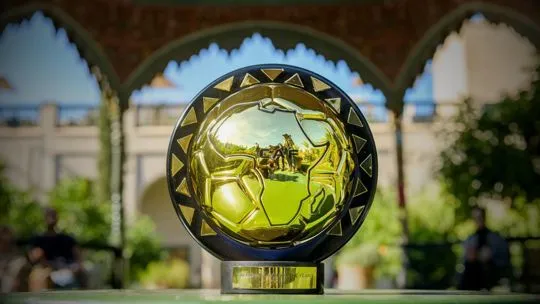
The Confederation of African Football (CAF) has moved the 2026 CAF Awards forward by five days, bringing one of African football’s biggest celebrations to Lagos on December 2. While the change gives Nigeria another opportunity to showcase its cultural influence and hospitality, the ceremony is arriving with an uncomfortable question for the country’s football supporters: why is Nigeria hosting the continent’s biggest football awards without a representative in either the men’s or women’s Player of the Year race?
CAF announced on Tuesday, November 10, that the ceremony would now take place on Wednesday, December 2, instead of the previously scheduled December 7. The venue remains the Professor Wole Soyinka Centre for Culture and Creative Arts, popularly known as the National Theatre, in Lagos.
The event will begin at 7 p.m. Nigerian time and is expected to attract leading African footballers, coaches, club officials, administrators and other personalities from across the continent.
Although CAF did not publicly provide a detailed explanation for the adjustment, a report by The Guardian quoted a CAF official as saying that European clubs were reluctant to release some nominated players for the original date. Moving the ceremony forward could therefore improve the chances of having more award nominees physically present in Lagos.
However, the scheduling adjustment is only one part of a bigger story. The 2026 edition will mark the return of the CAF Awards to Lagos after 12 years, creating an opportunity for Nigeria to demonstrate its importance to African football beyond what happens on the pitch.
Why Did CAF Move the 2026 Awards From December 7 to December 2?
The decision to move the CAF Awards forward appears to be connected to a familiar challenge in modern African football: the difficulty of getting players based in Europe to attend continental events.
Many of Africa’s biggest football stars play for European clubs, where domestic league matches, European competitions and training schedules determine their availability.
December is particularly complicated because European football does not stop for the Christmas period. The Premier League, La Liga, Bundesliga and other major competitions continue to schedule matches during the month.
This means that an awards ceremony scheduled for December 7 could clash with club commitments, making it difficult for some nominated players to travel to Nigeria.
According to The Guardian’s report, a CAF official explained that European clubs were reluctant to release players for the original date. The adjustment was intended to reduce the possibility of winners and nominees missing the ceremony.
It is an important consideration because an awards event loses some of its appeal when the players being celebrated cannot attend.
Imagine organising a major continental football celebration only for several of its biggest stars to watch from television or social media because their clubs will not release them.
CAF’s decision suggests that the physical presence of nominees matters to the organisation, not just the announcement of winners.
Nevertheless, the governing body has not formally confirmed that European club availability was its official reason for changing the date. What is clear is that the new schedule has been announced, while Lagos remains the host city.
Lagos Returns to the CAF Awards After 12 Years
The return of the CAF Awards to Lagos is arguably the most significant part of this year’s ceremony for Nigeria.
The city last hosted the awards in 2014, although that ceremony was eventually held on January 8, 2015. Before then, Lagos had also hosted editions in 2008 and 2013.
The return creates an opportunity to combine African football with Nigeria’s entertainment industry, cultural heritage and hospitality.
The Professor Wole Soyinka Centre for Culture and Creative Arts, formerly the National Theatre, provides a fitting location for an event that is expected to attract some of the continent’s most recognisable sporting personalities.
There is also a wider economic opportunity.
International sporting events can generate business for hotels, restaurants, transportation companies, event organisers and other service providers. The arrival of football officials, nominees, media representatives and international guests could provide additional activity for businesses in Lagos.
However, the real value of hosting should extend beyond one evening of entertainment.
Nigeria has the opportunity to demonstrate that it can organise major international sporting events successfully, attract global attention and provide an environment that encourages future continental competitions.
In my opinion, this is where the government and football authorities should focus. Hosting the CAF Awards should not simply be about putting up an impressive stage and welcoming celebrities. It should also be an opportunity to strengthen Nigeria’s reputation as a destination for international sports events.
Why Are There No Nigerian Players in the CAF Player of the Year Race?
While Lagos prepares to welcome Africa’s football stars, Nigerian supporters have another reason to pay attention to the nominations.
For the first time, no Nigerian player has made either the CAF Men’s Player of the Year or CAF Women’s Player of the Year shortlist.
This is particularly disappointing because Nigeria has traditionally been one of Africa’s strongest football nations, with a history of producing outstanding male and female players.
The Super Eagles and Super Falcons have both enjoyed considerable success at continental and international levels. Nigerian footballers have also made their mark in European leagues and other major competitions.
However, reputation alone cannot guarantee recognition at the CAF Awards.
The nominations are based on performances during the relevant assessment period, and other African players have produced stronger individual campaigns in the eyes of the selection process.
The absence of Nigerian players from the two headline categories should therefore prompt a conversation about the country’s current football development.
It is not necessarily evidence that Nigerian football has collapsed. But it does raise questions about the quality of performances, consistency, player development and the country’s ability to produce footballers competing at the highest level.
There is, however, some Nigerian representation in other categories.
Flamingos player Oluwakemi Adegbuyi and Janet Akekoromowei are among the nominees for the women’s young player award, while Edo Queens goalkeeper Christiana Uzoma is nominated in the goalkeeper category.
This is encouraging because it shows that Nigerian football still has emerging talents and players receiving continental recognition.
Still, the absence of a Nigerian representative in the two biggest individual categories will be a talking point when the ceremony arrives.
What Will the 2026 CAF Awards Recognise?
The 2026 CAF Awards will recognise outstanding achievements across 18 categories.
The most anticipated honours are the CAF Men’s Player of the Year and CAF Women’s Player of the Year awards.
Other categories will celebrate the performances of coaches, goalkeepers, emerging talents, clubs and national teams.
The awards are intended to recognise individuals and teams whose performances have made significant contributions to African football over the assessment period.
Voting opened on November 5 and will close on November 20.
CAF Member Associations and clubs are involved in the process, while eligible national team coaches and captains are also encouraged to participate. The organisation says independent monitoring will help protect the integrity and transparency of the selection process.
This means the next few days will be particularly important for the nominees as the voting process approaches its deadline.
For supporters, the final results will provide another opportunity to compare performances across African football and debate which players truly deserve continental recognition.
Can the CAF Awards Give Nigerian Football a Much-Needed Boost?
There is a difference between hosting a major football event and being a major force in the competition itself.
Nigeria will welcome Africa’s leading football personalities in December, but the absence of Nigerian nominees in the headline individual categories highlights a gap between the country’s hosting ambitions and its current recognition on the pitch.
This is something Nigerian football authorities should take seriously.
The country has a large population, an established football culture and a history of producing talented players. Yet those advantages must be supported by better administration, stronger domestic competitions, improved youth development and consistent investment in women’s and men’s football.
The recent success of the Flamingos at the FIFA U-17 Women’s World Cup is a reminder that Nigeria still has the potential to compete successfully on the international stage.
But success at youth level must translate into sustained development. Young players need quality coaching, competitive opportunities, proper facilities and a clear pathway into professional football.
The same applies to the domestic league. Nigerian clubs need better organisation, improved infrastructure and greater commercial support if they are to compete more effectively with leading African sides.
Hosting the CAF Awards could help draw attention to these opportunities, but the real test will be what Nigerian football does after the guests leave Lagos.
December 2 Could Be Bigger Than an Awards Ceremony
The 2026 CAF Awards will bring together football, entertainment and culture in Lagos, with 18 categories celebrating the achievements of African football.
The five-day adjustment may seem like a minor administrative decision, but it reflects the challenges of organising a continental event around the commitments of players competing in different parts of the world.
For Nigeria, the ceremony also presents an opportunity to welcome Africa’s biggest football personalities while showcasing Lagos to an international audience.
However, the absence of Nigerian nominees in the men’s and women’s Player of the Year races should not be ignored.
It is possible to celebrate the return of the awards to Lagos while also admitting that Nigerian football needs to do more to regain its place among Africa’s leading performers.
My take is that Nigeria should treat the 2026 CAF Awards as more than an opportunity to host a glamorous football night. It should be a moment to examine where the country’s football development is falling short and what must change before the next edition.
On December 2, Lagos will become the centre of African football celebrations. The bigger challenge for Nigeria is making sure that, by the next awards ceremony, its players are not just welcoming the continent’s stars but standing among the winners.