











Nigeria’s 2027 presidential election is still ahead, but the political battle is already producing developments that could determine its outcome long before voters reach the polling stations.
In Abuja, a Federal High Court has delivered a judgment that threatens former Vice President Atiku Abubakar’s presidential ambition under the African Democratic Congress (ADC).
In Calabar, Peter Obi’s political movement has faced an attack on its convoy during a town hall engagement. Meanwhile, Anambra State Governor Chukwuma Soludo has thrown his political weight behind President Bola Tinubu, promising to mobilise at least 50 per cent of his state’s votes for the incumbent.
Three developments. Three different political stories. But together, they reveal something much bigger about Nigeria’s road to 2027.
The opposition is dealing with legal uncertainty, questions about political security and an increasingly complicated alliance structure. Tinubu, meanwhile, appears to be benefiting from a political environment in which some of his potential challengers are struggling to consolidate their positions.
My concern is that Nigerians could enter another presidential election with more political drama than meaningful competition over the country’s future.
And that should worry anyone who believes a healthy democracy needs a strong opposition.
Atiku’s Presidential Ambition Hits a Legal Wall
The biggest immediate shock came on November 5, when a Federal High Court in Abuja nullified the leadership of the ADC under former Senate President David Mark and invalidated decisions taken by the caretaker committee.
Among the affected decisions was the process that produced Atiku Abubakar as the party’s presidential candidate for the 2027 election.
The court ruled that the caretaker committee responsible for organising the party’s affairs and presidential primary was not legally constituted.
The case followed a challenge by former ADC deputy national chairman Nafiu Bala Gombe, who questioned the legitimacy of the party’s leadership arrangements.
The judgment is particularly significant because Atiku had already secured the ADC ticket and selected former Rivers State Governor Rotimi Amaechi as his running mate.
In other words, the ruling does not merely create an administrative problem for the party. It threatens the foundation of its presidential campaign.
Atiku’s camp has strongly rejected the judgment, describing it as a deliberate attempt to frustrate the opposition. His representatives have announced plans to challenge the decision at the Court of Appeal.
The former vice president also questioned the timing of the case, arguing that it was intended to weaken his political support, particularly in northern Nigeria.
However, there is an important distinction here: the court’s decision is not necessarily the final word. The appeal process could change the legal position, and the political implications will depend partly on how quickly the dispute is resolved.
Nevertheless, the timing creates a serious challenge.
With the 2027 election approaching, the ADC cannot afford to spend months fighting over who has the authority to represent it. Every day spent resolving internal disputes is another day its competitors can use to organise, campaign and strengthen their political networks.
For Atiku, this is another difficult chapter in a presidential journey that has already spanned several election cycles.
Peter Obi’s Calabar Experience Raises a More Dangerous Question
While Atiku is dealing with a courtroom battle, Peter Obi has encountered a different kind of political challenge.
On November 4, Obi’s convoy came under attack in Calabar, Cross River State, during his political engagement ahead of the 2027 election.
The incident happened around the Watt Market area as the convoy was returning from the palace of the Obong of Calabar to the Metropolitan Hotel, where the Nigeria Democratic Congress (NDC) was scheduled to hold a town hall meeting.
Reports indicated that suspected attackers armed with dangerous objects damaged vehicles in the convoy, smashing windscreens and causing panic among supporters and traders in the area.
Obi later described how his security team advised him to take another route after the attackers confronted the convoy.
He nevertheless proceeded with his scheduled engagement.
The Cross River State Police Command confirmed that a 27-year-old suspect, identified as Victor Edet Yellow-Duke, had been arrested. Police said investigations were ongoing to identify others involved.
It is important to note that no political party has been established as responsible for organising the attack.
Obi condemned the incident and warned that Nigerians should not allow political violence to become normal ahead of the 2027 elections.
His warning deserves attention.
Nigeria has a history of politically charged confrontations, and violence during campaign activities can discourage citizens from participating in the democratic process.
A political candidate should be able to visit a community, address supporters and present his ideas without worrying about being attacked.
But beyond the immediate incident, there is another issue worth considering.
Obi is trying to build a political movement around public engagement, town hall meetings and direct interaction with Nigerians. If such activities become vulnerable to intimidation, the movement’s ability to reach voters could be affected.
The police must therefore ensure that the investigation goes beyond making one arrest. Nigerians deserve to know who was involved, what happened and whether anyone else was responsible.
Political violence should never become another tool in the competition for power.
Soludo’s Tinubu Endorsement Changes the Political Conversation
Perhaps the most interesting political development came from Anambra State.
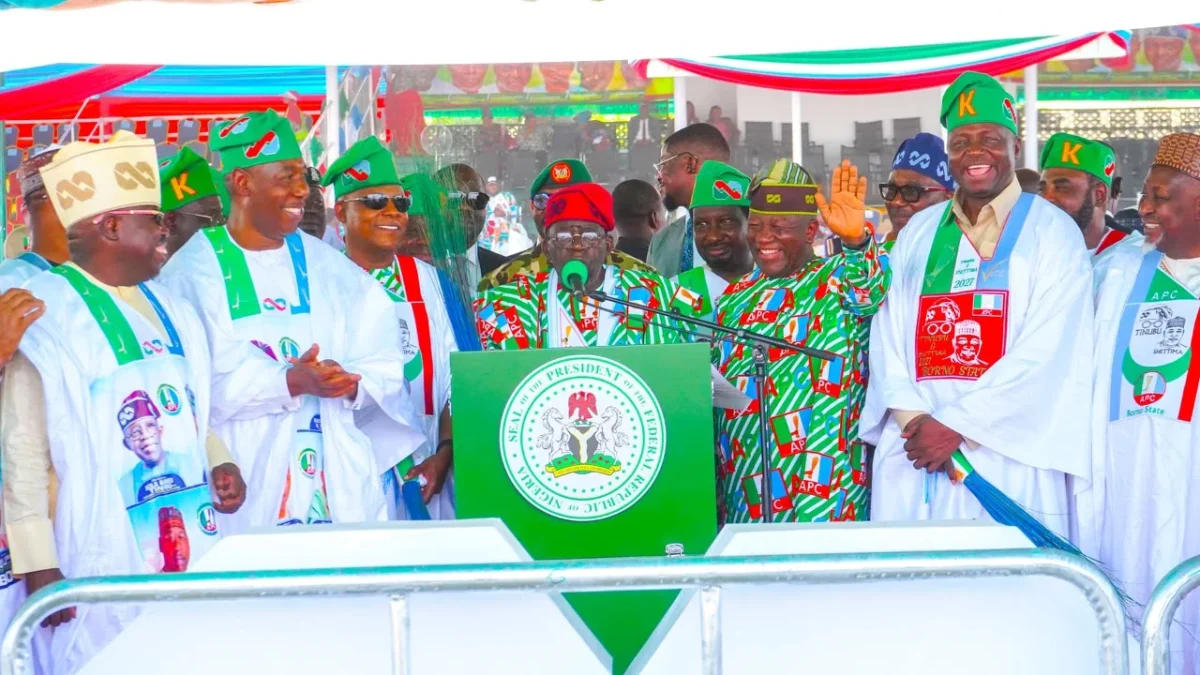
Governor Chukwuma Soludo has pledged that the All Progressives Grand Alliance (APGA) will support President Bola Tinubu in the 2027 presidential election rather than present its own candidate.
At the party’s 2027 campaign flag-off at Alex Ekwueme Square in Awka on November 6, Soludo formally adopted Tinubu as APGA’s preferred presidential candidate.
He also promised to mobilise at least 50 per cent of Anambra’s votes for the president.
That is a significant political declaration, particularly considering the state’s voting pattern in the 2023 election.
Soludo recalled that Tinubu received fewer than 5,000 votes in Anambra during that election. He argued that the president had continued to demonstrate concern for the South-East despite the relatively small electoral support he received.
The governor also pointed to Tinubu’s earlier appointments of Anambra indigenes to strategic positions during his time as Lagos State governor.
His argument is essentially political: stronger support for the president could give Anambra and the wider South-East greater access to the Federal Government and improve their ability to negotiate for development.
Whether voters will accept that argument is another matter.
Soludo’s endorsement is important, but it does not automatically mean that APGA members or Anambra residents will vote as instructed.
The 50 per cent target is a political promise, not an established electoral outcome.
Still, the development gives Tinubu another opportunity to strengthen his support in a region where his performance in 2023 was particularly weak.
It also demonstrates how regional political calculations could become central to the 2027 contest.
Is Tinubu Quietly Benefiting From Opposition Disunity?
This is where the three developments become particularly interesting.
Atiku and Obi were among Tinubu’s strongest challengers in the 2023 presidential election. Atiku finished second, while Obi finished third.
Both men attracted significant support from different parts of the country, and both continue to command considerable political attention.
However, they are now pursuing their ambitions through different political platforms.
Atiku is with the ADC, while Obi is leading the NDC.
That separation creates an obvious challenge for the opposition: how can different political movements challenge the same incumbent effectively if they cannot agree on a common strategy?
The legal troubles facing Atiku’s party could make the situation even more complicated.
Obi, meanwhile, is building his own national campaign while dealing with the security concerns raised by the Calabar incident.
Tinubu has an advantage that should not be underestimated: incumbency.
He has access to an established political structure, a national governing party and relationships with political leaders across several states.
His re-election campaign was already launched in October, giving the APC an early opportunity to organise its political machinery.
Soludo’s endorsement adds another interesting dimension to that structure.
In my opinion, the opposition’s biggest problem may not necessarily be the popularity of the ruling party. It may be its inability to organise its own strength into a credible alternative.
Nigerians who want a change of government need more than popular personalities. They need a political structure capable of competing across the country, presenting clear policies and protecting its candidates’ interests.
Without that, public dissatisfaction may not automatically translate into electoral victory.
The Real Battle Is Bigger Than Atiku, Obi and Tinubu
It would be easy to interpret these developments as another round of political competition between familiar personalities.
But Nigeria’s problems are much bigger than the ambitions of individual politicians.
The country is still dealing with economic pressure, insecurity, unemployment and concerns about the cost of living.
These are the issues that should dominate the 2027 election.
What does Atiku intend to do differently about the economy? What is Obi’s practical plan for reducing unemployment and improving public services? How does Tinubu intend to convince Nigerians that his economic reforms will produce better living conditions?
These are the questions voters should be asking.
Political endorsements, court judgments and campaign attacks may determine who gets an advantage, but they do not automatically determine who has the best policies.
I also believe Nigeria needs an opposition that understands the difference between criticising the government and presenting a convincing alternative.
Opposition politicians cannot simply rely on public anger against the APC. They must demonstrate that they can govern, build coalitions and manage the country’s complicated political and economic realities.
At the same time, the ruling party should not mistake divisions among its opponents for unconditional public approval.
A divided opposition may improve an incumbent’s electoral chances, but it does not erase the concerns of dissatisfied citizens.
2027 Could Be Decided Before the Campaign Reaches Its Peak
Nigeria’s 2027 election is shaping up to be a contest involving more than campaign promises and political rallies.
The ADC’s legal battle, the attack on Obi’s convoy and APGA’s endorsement of Tinubu reveal how much influence political organisation, security and regional alliances could have on the outcome.
Atiku must protect his candidacy through the courts. Obi must expand his political support while ensuring his movement can campaign safely. Tinubu must turn endorsements and political alliances into actual votes.
None of these developments guarantees an election victory.
There is still time for political alliances to change, court decisions to be overturned and new contenders to emerge.
But one thing is becoming clear: the opposition cannot afford to waste the months ahead.
My biggest concern is that Nigerian politics could become so focused on who defeats whom that the actual problems facing voters receive less attention.
A presidential election should be a competition of ideas, leadership and measurable promises. It should not be decided by political intimidation, endless party disputes or the ability to secure the largest number of elite endorsements.
Tinubu may be gaining political ground, but the real question is whether his opponents can put their differences aside and offer Nigerians a credible choice before 2027 arrives.



One thought on “SPECIAL FEATURE: Is Nigeria’s Opposition Already Losing the 2027 Election Before Voting Begins?”