











Rema has reached a major career milestone, with ChartMasters estimating his consumption-based sales at 10.01 million equivalent album units as of October 20, 2026. The achievement places him among Africa’s leading artists by this measure, alongside Burna Boy, Wizkid and Asake.
What makes the achievement interesting is not just the number. Rema has built a global audience with a relatively compact discography, using a mix of Afrobeats, pop and electronic influences to reach listeners far beyond Nigeria.
His success also reflects a wider shift in the music industry. An artist no longer needs to sell millions of physical CDs to reach a large audience. Streaming, international collaborations, playlist placements and songs that remain popular years after release can all contribute to an artist’s long-term commercial performance.
But the milestone raises a bigger question: does reaching 10 million equivalent album sales mean Rema is catching up with Africa’s biggest music stars, or does it reveal how the rules of music success have changed?
The answer is a little of both. Rema’s numbers show that Nigerian music has become a serious force in the global market. They also show why the way those numbers are calculated matters when comparing artists.
How Does Rema Compare With Burna Boy, Wizkid and Asake?
ChartMasters’ October 20, 2026, figures place Rema fourth among the four Nigerian artists highlighted in the ranking. The figures below represent equivalent album sales, not simply physical albums purchased by fans.
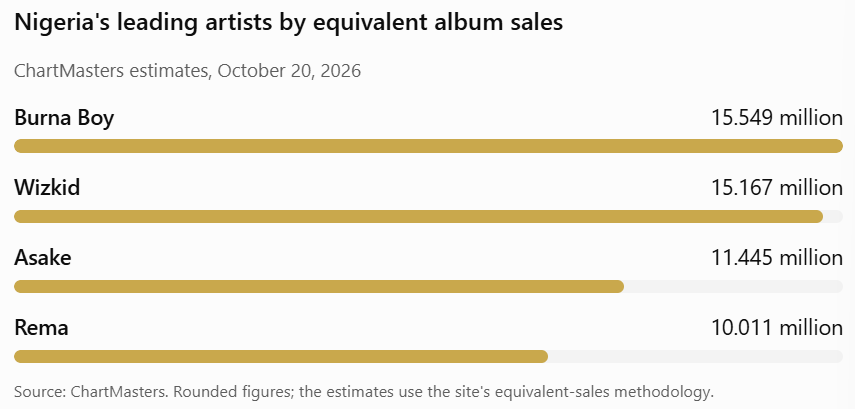
Burna Boy leads the group with approximately 15.55 million equivalent units, followed by Wizkid with 15.17 million. Asake sits third with 11.45 million, while Rema has crossed the 10 million mark at 10.01 million.
The gap between Rema and Asake is approximately 1.43 million units. Rema is about 5.16 million units behind Burna Boy, meaning he still has considerable ground to cover if he wants to catch the current leader.
These numbers make the milestone more interesting than a simple celebration of a round figure. Rema has reached a major commercial level, but the ranking also shows that sustained output and long-term audience demand remain important.
The four artists have different musical identities and career paths. Burna Boy has built a catalogue that blends Afrofusion with global influences, Wizkid has maintained a long career through collaborations and major solo releases, and Asake has developed a distinctive sound combining street-pop, Afrobeats and Fuji influences.
Rema’s position is especially notable because his international rise accelerated with songs that travelled beyond the traditional Afrobeats audience. His success suggests that a younger artist can build substantial global demand without following exactly the same career path as established stars.
However, rankings can change as songs accumulate streams and new projects arrive. Rema’s fourth position should be viewed as a snapshot of the available estimates, not a permanent verdict on the artists’ commercial standing.
Why Is Rema’s Discography Performing So Well?
Rema’s catalogue offers one explanation for the milestone. His music has found listeners through several routes, including streaming platforms, international collaborations, viral clips and songs that continue to attract new audiences long after their release.
His 2022 album, Rave & Roses, remains a particularly important part of that story. The album’s international reach grew substantially with the success of Calm Down, especially the remix featuring Selena Gomez.
The remix helped introduce Rema to listeners who might not otherwise have sought out Nigerian music. It connected his sound with a wider pop audience while keeping the original song’s Afrobeats identity at its centre.
The effect of a global hit can extend far beyond its own streaming numbers. New listeners often move from a popular single to the artist’s older releases, albums and collaborations. A successful song can therefore become an entry point into an entire catalogue.
ChartMasters’ Afrobeats data identifies Rave & Roses as one of the leading albums by streaming performance, with more than 3.5 billion Spotify streams listed in its October 2026 data.
That is a significant contribution to Rema’s overall visibility. It also illustrates why the commercial value of an album does not necessarily stop when its promotional campaign ends.
In the streaming era, a song can keep generating attention years after its release. Fans may discover it through playlists, social media, films, live performances or recommendations from other listeners. When that happens, the artist’s older catalogue can remain commercially active even without a new album.
Rema’s achievement is therefore not only about how many records he has released. It is also about how effectively his strongest songs continue to attract listeners.
Analysis: Why Streaming Has Changed the Meaning of Album Sales
The phrase “10 million album sales” can be misleading if readers assume it means 10 million people bought complete albums.
ChartMasters uses a method known as Commensurate Sales to Popularity Concept, or CSPC, to estimate equivalent album sales across different formats. The methodology converts activity from streaming and other formats into a common unit for comparing artists’ commercial reach.
That distinction matters because the music industry has changed considerably. Physical album purchases and digital downloads once provided a clearer picture of sales. Today, many listeners consume music through subscription services and ad-supported platforms, often without purchasing an album outright.
Equivalent album sales attempt to make these different forms of consumption comparable. But the resulting figures are estimates, not a direct count of physical albums sold.
They also depend on the assumptions used to convert streams, videos and other activity into equivalent units. Different organisations can use different rules, so their rankings may not match exactly.
This does not make the figures useless. They can help explain the scale of an artist’s catalogue and allow comparisons across different periods. The important point is to describe the numbers accurately.
For Rema, the 10.01 million figure is evidence of substantial recorded-music consumption under ChartMasters’ methodology. It should not be presented as proof that 10 million individual albums were purchased.
The distinction is particularly important for Nigerian artists, whose international growth has been closely tied to streaming. Their success increasingly depends on whether songs can attract listeners across countries and remain popular over time.
In my view, the most useful lesson from Rema’s milestone is that global music success now involves more than album-release campaigns. Artists need music that people return to, songs that travel between audiences and catalogues that remain discoverable after the initial excitement fades.
What Does Rema’s Milestone Mean for Afrobeats?
The fact that all four artists in this ranking are Nigerian is a reminder of how strongly Nigeria has positioned itself within the global Afrobeats movement.
For years, Nigerian music had a large audience at home and across the African diaspora. Artists could build successful careers through local radio, live performances, regional collaborations and international communities. Streaming has made it easier for their music to reach listeners who have no direct connection to Nigeria.
Rema’s success is part of that transition. His music combines elements of Afrobeats with pop and other contemporary sounds, giving it opportunities to reach audiences in different markets. The success of Calm Down showed how a Nigerian song could become a global hit without losing its identity.
There are commercial benefits to this wider reach. International popularity can strengthen an artist’s negotiating position with labels, promoters and brands. It can also support overseas tours, festival appearances and collaborations with musicians from other markets.
Yet streaming figures alone do not reveal how much money an artist earns. Revenue depends on factors such as the platform, the listener’s country, rights ownership, label agreements and the division of royalties among contributors.
A song with billions of streams can generate substantial attention without every person involved receiving the same financial benefit. For Nigerian music to turn global popularity into lasting industry growth, artists and music businesses need strong rights management, transparent contracts and effective royalty collection.
That is why Rema’s milestone matters beyond fan celebrations. It highlights the commercial potential of Nigerian music while raising questions about how much value the industry can retain from its international success.
Can Rema Catch Burna Boy and Wizkid?
Rema has room to climb the ranking, but overtaking Burna Boy or Wizkid will depend on how his catalogue performs over the coming years.
Based on the October 20 figures, Rema needs approximately 1.43 million additional equivalent units to reach Asake’s current total, 5.16 million to match Burna Boy and 5.16 million to match Wizkid? Not quite: Wizkid’s lead over Rema is approximately 5.16 million, while Burna Boy’s lead is approximately 5.54 million. These gaps will change as the artists accumulate more activity.
New releases could help Rema close the distance, but a new album is not the only way to do it. Strong singles, successful collaborations, international touring and continued interest in older songs can all contribute to catalogue growth.
The same applies to his competitors. Burna Boy and Wizkid have extensive catalogues, and Asake’s releases continue to attract listeners. Their totals are not standing still while Rema advances.
It is also worth remembering that a ranking based on equivalent album sales measures one aspect of success. It does not settle debates about artistic quality, cultural influence, live performance or which artist has had the greatest impact on Afrobeats.
Rema does not need to overtake every established star for his milestone to be significant. Crossing 10 million equivalent units already places him among the leading Nigerian artists on this particular measure.
The more interesting question is whether he can maintain that momentum while continuing to develop his sound and expand his audience.
What Should Fans Watch Next?
The next phase of Rema’s career will be worth watching for three reasons.
First, his future releases will show whether he can build on the audience created by Calm Down and Rave & Roses. A successful follow-up project could give his catalogue another major source of long-term streaming activity.
Second, the performance of his older songs will remain important. If tracks continue attracting listeners between major releases, his overall equivalent-sales total could rise steadily without depending entirely on a new hit.
Third, his international reach could influence the next generation of Nigerian artists. Younger musicians are watching how Nigerian sounds can cross borders, how collaborations can introduce music to new audiences and how a successful song can create opportunities far beyond streaming.
Still, the industry should avoid treating every milestone as a competition between individual artists. Burna Boy, Wizkid, Asake and Rema have all contributed to Nigeria’s growing international music profile in different ways.
Their success demonstrates that Afrobeats is not dependent on one artist or one sound. It is an expanding movement with room for different styles, audiences and commercial strategies.
Rema’s 10.01 million equivalent album sales mark an important stage in that story. His next challenge is to turn a strong catalogue and international recognition into sustained success.




One thought on “Is Rema’s 10 Million Album Sales Milestone Proof of Afrobeats’ Global Power?”