




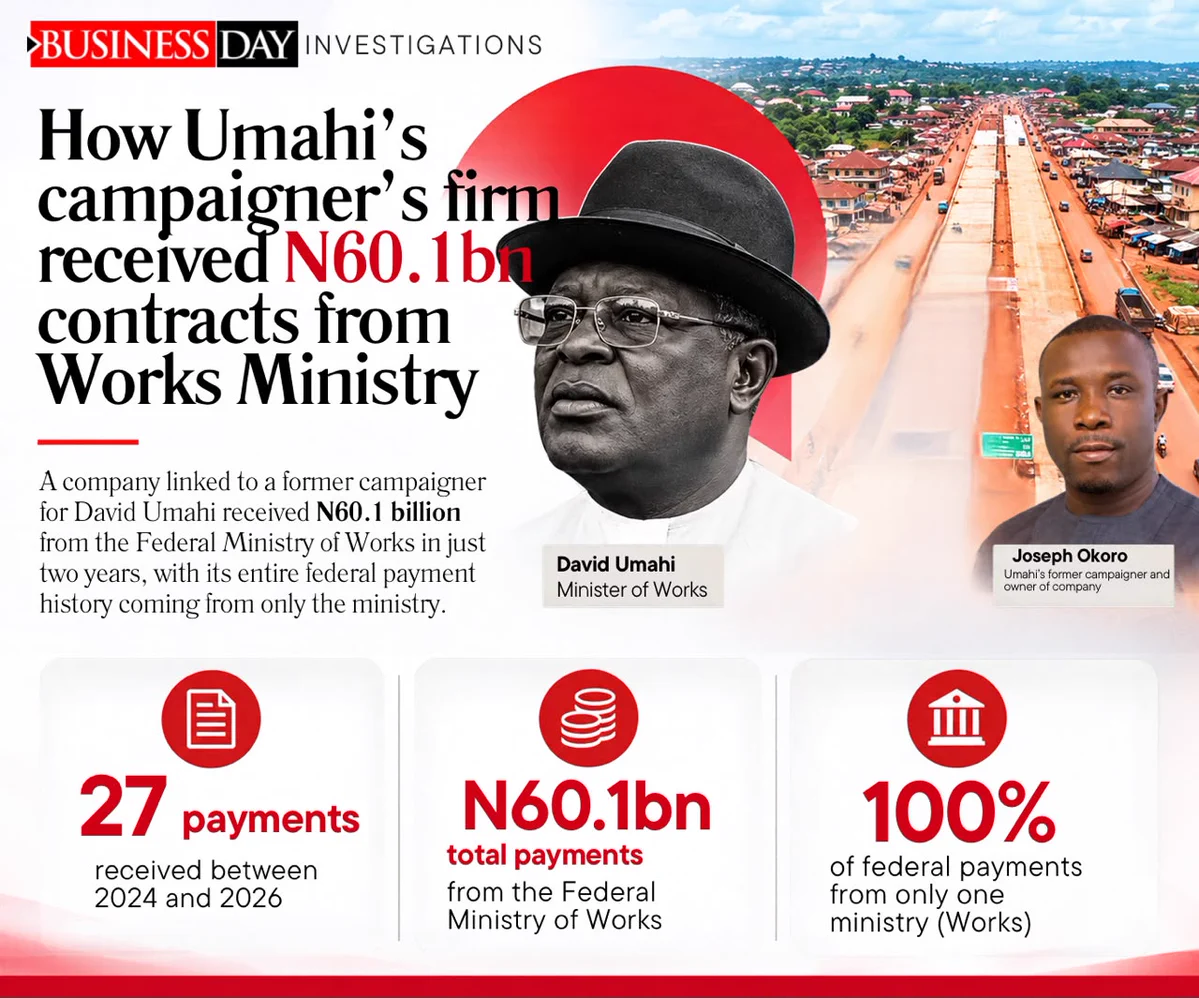
A BusinessDay investigation has raised questions over ₦60.1 billion in payments from Nigeria’s Federal Ministry of Works to Reinforced Global Resources Limited, a company owned by Joshua Okoro, a former supporter of Works Minister David Umahi.
According to the investigation, the company received the money through 27 transactions between 2024 and 2026. The payments were connected to federal road projects, including the Enugu-Abakaliki-Ogoja Road.
The central issue is not only the size of the payments. It is how the contracts were awarded and paid for, and whether the process followed Nigeria’s public procurement rules.
What the Investigation Found
BusinessDay reported that Reinforced Global Resources received all of its federal payments from the Ministry of Works during the period examined.
The investigation alleges that some of the contracts involved large advance payments and that competitive bidding requirements were not followed in some cases. Procurement expert Lukman Adefolahan told BusinessDay that the circumstances raised potential conflict-of-interest concerns.
These are allegations reported by the newspaper and should not be treated as proof of wrongdoing. The minister and Reinforced Global Resources had not publicly responded to the investigation at the time of publication.
Why the Procurement Process Matters
Nigeria’s Public Procurement Act 2007 establishes rules intended to promote transparency, competition and accountability in government contracting.
That makes the procurement process particularly important when large public funds are involved. The Federal Ministry of Works manages some of the country’s biggest infrastructure projects, meaning contract decisions can involve billions of naira.
The ministry has previously acknowledged the financial scale of its road programme. In January 2024, Umahi said the Federal Government owed contractors about ₦1.5 trillion and said payments would be made after claims were verified.
More recently, the ministry has continued to highlight major spending on road infrastructure. In August 2026, Umahi said more than ₦200 billion had been spent on the Abuja-Kaduna-Zaria-Kano road project.
The Political Connection Adds Another Layer
The reported connection between Okoro and Umahi makes the story more politically sensitive. Okoro is described in the BusinessDay investigation as a former supporter of Umahi. That relationship does not by itself establish that the payments were improper, but it is one of the reasons the investigation has drawn attention to the contracts.
The wider question is whether government procurement systems provide enough safeguards when contractors have previous political or personal connections with public officials.
What Happens Next?
The immediate issue is whether the ministry, the company or relevant procurement authorities respond to the allegations.
The investigation also puts attention on the documentation behind the 27 transactions, including contract awards, tender processes, payment schedules and the work delivered on the affected roads.
Until those records and responses are examined, the ₦60.1 billion figure is best understood as the amount BusinessDay says it identified in its investigation, while the alleged procurement breaches remain claims requiring further verification.
For a ministry responsible for billions of naira in infrastructure spending, the controversy ultimately puts the spotlight on a simple question: how transparent was the process behind these contracts?