








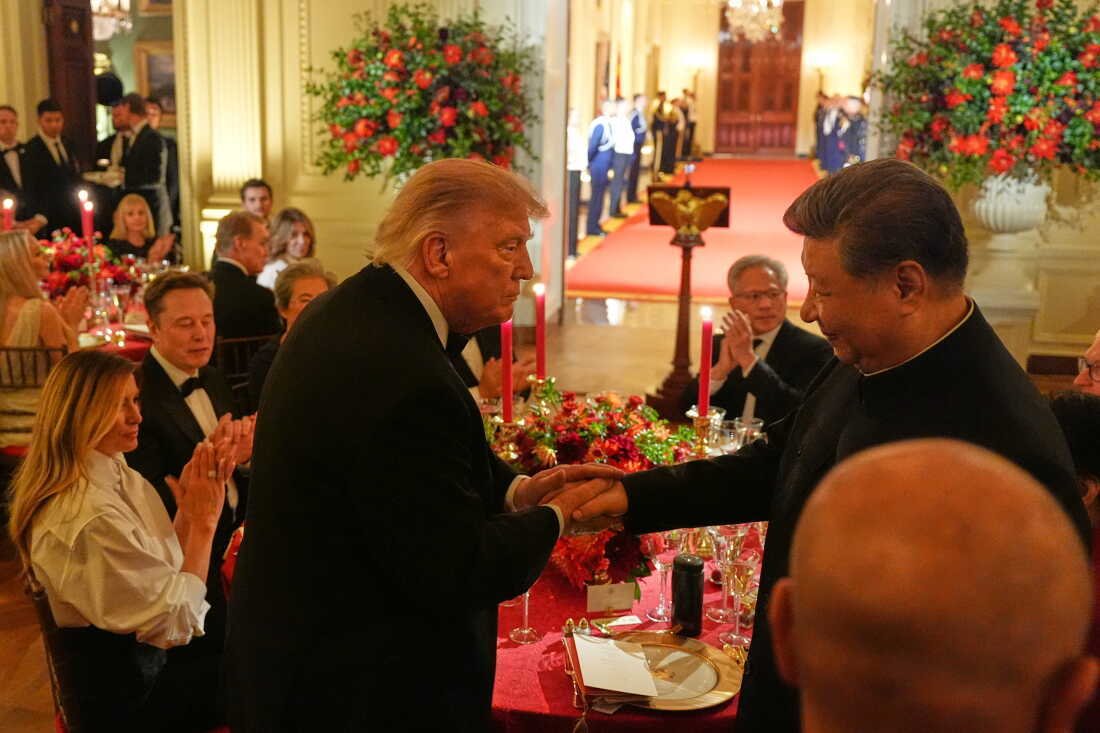
US President Donald Trump hosted Chinese President Xi Jinping at the White House state dinner on September 24, 2026, bringing together two of the world’s most powerful leaders and some of America’s biggest technology executives.
The dinner followed hours of talks between Trump and Xi on issues including trade, Taiwan, artificial intelligence and the Iran war. The high-profile guest list included technology leaders such as Elon Musk, Jeff Bezos, Mark Zuckerberg, Sam Altman and Nvidia’s Jensen Huang.
The unusual gathering placed the technology industry close to the centre of one of the most important US-China diplomatic meetings in years.
Why AI Became a Major Talking Point
Artificial intelligence was one of the most important issues discussed during the Trump-Xi White House meeting.
Xi said China and the United States have both the capability and responsibility to develop AI for public benefit while ensuring that its development remains under human control. His comments came as both countries compete for leadership in advanced AI technology.
The comments also highlighted a difference in approach. Trump had previously indicated that he did not want additional limits on AI development, making the question of how much regulation or oversight should apply to advanced AI an important point of discussion between Washington and Beijing.
With executives from OpenAI, Tesla, Amazon and Nvidia among the dinner guests, the discussion was not limited to government officials. The companies represented at the dinner are directly involved in the technology race that is shaping the US-China relationship.
Xi Also Addresses the Iran War
The Trump-Xi state dinner also came as the United States and Iran remained locked in a conflict that has affected regional security and global energy routes.
Xi expressed support for a US-Iran deal aimed at ending the war and reopening the Strait of Hormuz, according to reports on his meeting with Trump. The Chinese position adds another diplomatic voice to efforts surrounding the conflict.
The issue matters beyond the Middle East because the Strait of Hormuz is a major route for global energy shipments. Any prolonged disruption could affect oil markets and economies far beyond the region.
A Symbolic Meeting With Major Issues Still Unresolved
The elaborate state dinner provided a public display of warmer engagement between Washington and Beijing, but the major disagreements between the two countries have not disappeared.
Trade, Taiwan, technology, critical minerals and AI remain sensitive issues in the US-China relationship. Reuters reported that the leaders’ meeting did not produce a major breakthrough, even as both sides continued to emphasise dialogue.
For the technology industry, however, the dinner offered a striking picture of where global diplomacy is heading. AI is no longer simply a business or technology issue. It is increasingly tied to national security, international competition and the relationship between the world’s two largest economies.