





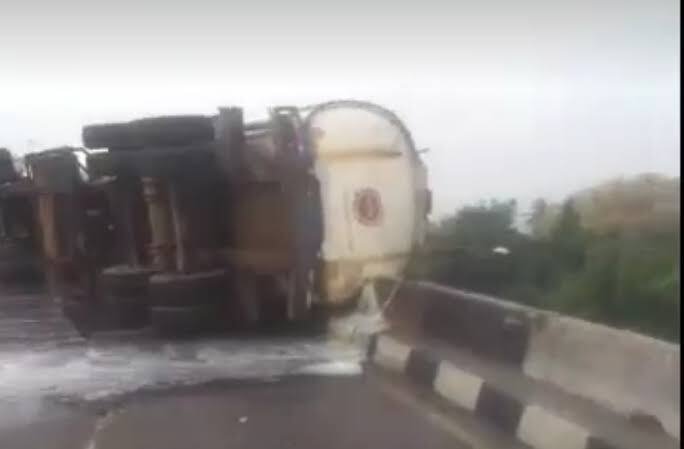
A tanker overturning on a Lagos road should normally be a road safety emergency. But videos showing residents rushing to scoop diesel from an overturned tanker reveal something much bigger: poverty in Nigeria is pushing people towards risks they know could kill them.
The recent Lagos tanker incident saw residents gather around spilled diesel with containers, despite the obvious fire risk. Diesel is highly flammable, and a spark, hot engine or other ignition source could turn the scene into a disaster within seconds. Similar scenes have been reported before, including at the Tincan-Liverpool Bridge in Lagos, where residents were also seen collecting fuel from an overturned tanker.
The question, therefore, is not simply why people would risk their lives for spilled fuel. It is why free fuel has become valuable enough for Nigerians to gamble with their lives.
Nigeria Has Seen This Tragedy Before
This is not a new problem. In October 2024, more than 140 people were killed when residents rushed to collect petrol from an overturned tanker in Majiya, Jigawa State. The crowd gathered around the leaking tanker before it exploded.
Just three months later, another devastating tanker explosion in Niger State killed at least 98 people near Dikko Junction in January 2025. Many of the victims had gathered to collect petrol from the crashed tanker.
The pattern continued. In October 2025, at least 31 people died in another tanker explosion in Niger State after residents rushed towards spilled petrol. Associated Press noted that rising fuel prices after subsidy removal had made fuel scavenging increasingly common.
These incidents show that the Lagos tanker incident is not an isolated act of recklessness. It is part of a wider national problem.
When Poverty Changes the Meaning of Danger
For someone struggling to afford fuel, a tanker spilling thousands of litres onto the road can look less like an emergency and more like an opportunity. That does not make the decision safe. It explains why warnings alone have repeatedly failed.
Nigeria has experienced a sharp increase in fuel costs since the removal of petrol subsidies, adding pressure to households already dealing with higher living costs. The result is a dangerous situation where something that should be treated as hazardous waste can be viewed as free economic value.
This is why blaming the people at the scene is not enough. There must be stronger emergency responses around overturned tankers, faster road closures, better public education and tougher enforcement. At the same time, the government has to address the economic conditions that make people willing to take such extreme risks.
The Real Warning From Lagos
Every overturned tanker cannot become a potential mass grave. The authorities may successfully prevent an explosion at this latest Lagos tanker incident, but the next tanker could overturn somewhere else tomorrow.
And if the same economic desperation remains, people may once again run towards the danger. The lesson from Nigeria’s previous tanker explosions is painfully clear: poverty does not remove people’s understanding of danger. Sometimes, it simply makes the reward seem worth the risk.