










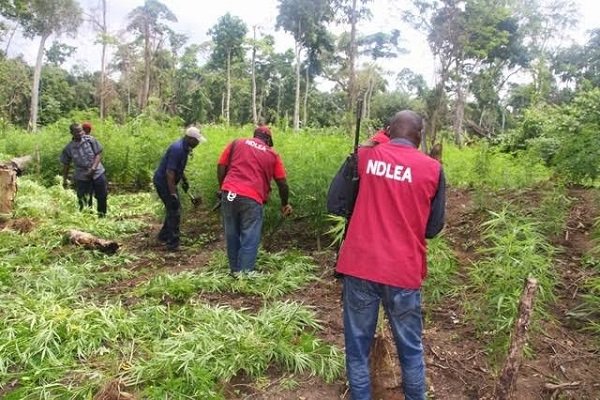
The National Drug Law Enforcement Agency’s latest destruction of cannabis farms in Edo State has reopened an argument Nigeria has struggled with for years: is the country destroying an illegal drug problem, or destroying a potential legal industry before it has decided what that industry could become?
On August 17, NDLEA operatives destroyed two cannabis plantations in Edo with an estimated yield of 4,628.9kg and arrested 10 suspects in separate operations. The farms were located around Ugboku in Igbanke Forest, while other arrests were made during raids in Oluku and Abuja Quarters in Benin City.
Under Nigeria’s current law, the NDLEA is doing what it is supposed to do. Cannabis cultivation for illicit purposes remains illegal, and the agency has repeatedly identified cannabis production and trafficking as a major drug-control problem. NDLEA data also shows that cannabis cultivation remains high in states including Edo, Ondo, Osun, Oyo and Delta.
But the latest operation has triggered a different conversation.
What If Some of This Land Had Economic Value?
Activist Omoyele Sowore criticized the destruction, arguing that burning cannabis is wasteful when Nigeria is struggling with unemployment and government revenue. The argument is not necessarily that Nigeria should allow people to grow and sell cannabis freely. There is another option: regulation.
Nigeria could theoretically create a tightly controlled system for medical research, pharmaceutical production or industrial cannabis, with licensed farmers, processors and exporters operating under government supervision.
There has already been legislative interest in this direction. A proposed National Assembly bill has previously sought to regulate the cultivation, processing and trade of cannabis for medical and research purposes, including licensing farmers and processors.
But Legalisation Is Not a Simple Money-Making Solution
The other side of the debate is important. Nigeria’s drug authorities argue that cannabis abuse remains a serious public-health concern. Nigeria told the UN that cannabis was the country’s most abused drug and that non-medical legalization would conflict with its obligations under international drug-control treaties.
So the real debate should probably not be framed as “burn it or legalize it.” The more useful question is whether Nigeria can distinguish between cannabis intended for recreational abuse and cannabis cultivated under strict controls for medical, scientific or industrial purposes.
Other countries have already created different regulatory models, but Nigeria would have to consider its own public-health risks, enforcement capacity and international obligations.
Edo Shows Why the Debate Is Getting Harder to Ignore
The scale of the latest seizure is part of the reason this argument keeps returning. Nearly 4.6 tons from just two plantations shows that cannabis cultivation is not a small underground activity. There is already an agricultural supply chain around the crop, even though much of it operates outside the law.
That creates a policy choice for Nigeria. It can continue destroying illegal farms and arresting those involved, which remains necessary where the crop is intended for illicit drug markets. Or it can also seriously investigate whether a controlled legal cannabis industry could create jobs, support farmers and generate tax revenue without increasing drug abuse.
The NDLEA’s latest operation may have destroyed 4.6 tonnes of cannabis, but it has also revived a question Nigeria has not answered: is cannabis only a drug problem, or could tightly regulated cannabis become an economic opportunity too?



One thought on “Nigeria Keeps Destroying Cannabis Farms While a Bigger Economic Debate Grows”