











Nigeria’s petrol subsidy debate has returned to the spotlight after former presidential candidate Adewole Adebayo argued that revenue from stolen or unaccounted-for crude oil could have helped keep petrol prices at ₦200 per litre.
The claim raises a question that goes beyond the price Nigerians pay at filling stations: how much has crude oil theft cost the country, and could recovering those losses realistically have prevented the removal of the petrol subsidy?
Adebayo, the Social Democratic Party’s presidential candidate in the 2023 election, made the remarks during a briefing with journalists in Abuja on Sunday, October 25, 2026. He argued that Nigerians should not have to pay international market prices for petroleum products when their country produces crude oil.
His comments arrive as households and businesses continue to struggle with fuel costs following President Bola Tinubu’s removal of the petrol subsidy in May 2023. They also reopen a political argument about whether the reform was unavoidable or whether Nigeria could have pursued a different approach.
However, the central issue is not simply whether Nigeria has lost money through crude oil theft. It is whether recovering those losses would provide a sustainable way to reduce petrol prices without creating another financial burden for the government.
What Did Adewole Adebayo Say About Stolen Crude Oil and Petrol Prices?
Adebayo argued that the volume of crude oil stolen or left unaccounted for in Nigeria could have supported a petrol subsidy that kept prices at ₦200 per litre.
He criticised the policy of charging Nigerians prices linked to international market conditions despite the country’s oil resources. In his view, Nigeria should be using its petroleum wealth to provide more affordable energy to its citizens rather than exposing them to the full cost of market prices.
The former presidential candidate has previously proposed reducing petrol, cooking gas and aviation fuel prices to ₦200 per litre within 12 months of taking office if elected in 2027. His earlier proposal included rehabilitating existing refineries, supporting modular refineries and using revenue from other petroleum products to sustain the pricing arrangement.
This suggests that his latest comments form part of a broader economic argument, not merely a complaint about the current pump price.
His position appeals to a concern shared by many Nigerians: how can a country with substantial crude oil reserves continue to struggle with expensive fuel?
Yet there is an important distinction between having crude oil underground, recovering oil lost to theft and producing petrol at a price consumers can afford. Those are related issues, but solving one does not automatically solve the others.
How Much Is Nigeria Losing to Crude Oil Theft?
Nigeria has struggled for years with crude oil theft, pipeline vandalism, illegal connections and weaknesses in measuring production. These problems reduce the volume of oil that reaches legitimate buyers and can deprive the government of revenue.
Recent figures show that the problem has improved in some respects but remains serious. According to figures published by the Nigerian Upstream Petroleum Regulatory Commission, average daily crude oil losses fell from 102,900 barrels in 2021 to 9,100 barrels in 2025. However, losses rose again to 17,600 barrels per day between January and July 2026, a 93.4% increase from the 2025 average.
The latest increase matters because it shows that improvements in oil security are not necessarily permanent. Even after major reductions in theft, renewed losses can weaken government revenue and undermine efforts to increase production.
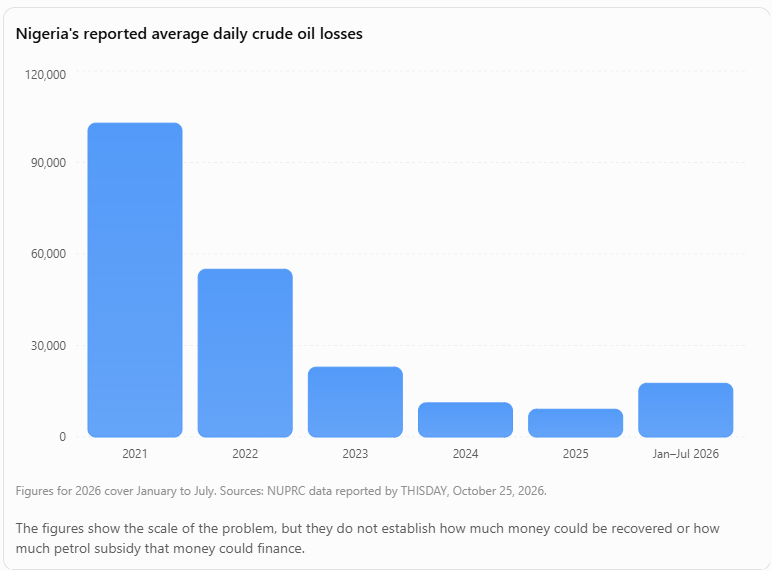
The figures demonstrate why crude oil theft deserves serious attention. Every barrel that is stolen or lost represents a potential loss of petroleum value, although the exact financial impact depends on the circumstances and the price at which the oil could have been sold.
However, these statistics do not prove Adebayo’s claim that stolen crude could have sustained petrol at ₦200 per litre. To establish that, the government would need to calculate the recoverable value of the lost oil and compare it with the cost of supplying petrol at that price.
The difference is important. A large financial loss does not automatically translate into an equally large amount of money available for public spending.
Could Nigeria Have Avoided the Petrol Subsidy Removal?
The question is worth examining because the petrol subsidy was not removed simply because Nigeria lacked crude oil. It was also a question of how much the government could afford to spend keeping prices artificially low.
On May 29, 2023, Tinubu announced the end of the subsidy during his inauguration. The policy change immediately became one of the most consequential economic decisions of his administration, pushing petrol prices higher and increasing transport and distribution costs across the country.
The World Bank had warned that the subsidy was placing a heavy burden on public finances. Its 2023 Nigeria Development Update estimated that the subsidy consumed 32.4% of government revenue in 2022, equivalent to about 2.2% of gross domestic product. The cost also exceeded the combined budget allocations for health, education and social protection.
Those figures help explain why the government wanted to end the arrangement. But they do not mean the previous system was without benefits for consumers. Cheap petrol reduced some transport and operating costs, even though the subsidy also created opportunities for smuggling and benefited people who consumed larger quantities of fuel.
Adebayo’s argument challenges the government’s decision to make consumers bear more of the cost while Nigeria continues to lose crude oil revenue.
There is a legitimate question here: could stronger oil security, better refinery performance and more transparent management of petroleum revenue have reduced the pressure to remove the subsidy?
It is a question worth asking. However, proving that a different policy would have worked requires more than pointing to the country’s oil wealth.
Why Stolen Crude Oil Does Not Automatically Mean Cheaper Petrol
One of the biggest gaps in the ₦200 petrol price argument is the assumption that recovering stolen crude oil would automatically make petrol affordable.
Crude oil is a raw material, not a finished product. It must be refined into petrol and other petroleum products before it reaches filling stations. That process involves refining costs, transportation, storage, distribution and other operating expenses.
The cost of crude oil itself is also affected by international market prices. Even when a country produces crude oil domestically, the value of that resource does not disappear simply because it is extracted locally.
Nigeria’s growing domestic refining capacity, including the Dangote refinery, could reduce dependence on imported petrol. But domestic refining alone does not guarantee that petrol will sell for ₦200 per litre. The cost of acquiring crude, refining it and delivering the finished product still matters.
There is also the question of how recovered oil would be used. If the government sold additional crude on the international market, the revenue could support public spending. If it supplied the crude to domestic refineries at a discounted price, that would be a different arrangement with different financial consequences.
To keep petrol at ₦200 while its actual supply cost remained substantially higher, someone would have to cover the difference. That could mean government spending, a discount from a refinery, cross-subsidisation through other petroleum products or another funding mechanism.
In other words, Adebayo’s proposal needs a transparent financial model showing how much crude could be recovered, how much petrol it could produce and how the remaining costs would be paid.
Without those details, ₦200 remains a political target rather than a demonstrated sustainable price.
What Do the Latest Oil Theft Figures Tell Us?
The increase in reported crude oil losses during the first seven months of 2026 makes the debate more urgent.
Although average daily losses fell from 102,900 barrels in 2021 to 9,100 barrels in 2025, the subsequent rise to 17,600 barrels per day shows that Nigeria still has a serious oil security problem.
The government therefore has two related tasks: prevent oil from being stolen and ensure that the revenue generated from legitimate production reaches the public treasury.
Improving pipeline surveillance and metering can help reduce losses, but the benefits must be visible in production figures, public revenue and the management of oil-sector finances.
The Nigerian National Petroleum Company Limited’s financial disclosures also show why petroleum revenue needs careful interpretation. In October 2026, reports on its 2025 audited financial statements highlighted ₦11.2 trillion in claims and receivables from the Federation, including energy security-related costs and advances. This was not simply a fresh cash payment or a direct measure of money lost to crude theft.
That distinction matters. Large figures can attract public attention, but they do not all represent money that could immediately be redirected towards lower petrol prices.
For Adebayo’s proposal to be evaluated properly, Nigerians need a breakdown of the value of recoverable crude, the costs of recovering and refining it, the expected government revenue and the amount required to maintain a ₦200 pump price.
The argument would be much stronger if supported by those figures.
What Would ₦200 Petrol Mean for Nigerian Households?
For many households, the appeal of cheaper petrol is obvious. Lower transport costs can leave families with more money for food, rent, school fees and healthcare. Businesses that rely on road transport, generators and delivery vehicles could also benefit.
The difference between the proposed price and current market conditions is enormous. Daily Post reported on October 26 that petrol was selling for approximately ₦1,370 to ₦1,429 per litre in Abuja. At those prices, a reduction to ₦200 would represent a cut of more than 85% per litre.
However, the effect on the wider economy would depend on whether that price could be maintained without creating shortages, large public debts or pressure on other government spending.
Nigeria has experienced the problems that can emerge when fuel prices are kept below supply costs without a reliable funding arrangement. If the government promises cheap petrol but cannot pay suppliers, the result could be delayed payments, reduced supply or renewed scarcity.
That is why the real goal should not simply be the lowest possible price announced by a politician. It should be a fuel supply system that offers affordable prices without repeatedly creating fiscal problems.
In my view, the strongest policy would combine reduced crude oil theft, efficient domestic refining, transparent petroleum revenue management and targeted support for households that struggle most with energy costs.
The government could also improve public transport to reduce how much families depend on petrol for everyday movement. These measures would not produce an overnight solution, but they could make the economy less vulnerable to future fuel price shocks.
Is the ₦200 Petrol Promise a 2027 Election Issue?
The timing of Adebayo’s remarks is significant because the fuel subsidy debate is becoming part of the political contest ahead of the 2027 presidential election.
Tinubu has defended subsidy removal as necessary to protect public finances, while opposition figures have challenged the policy and called for cheaper fuel. Adebayo has gone further by proposing a specific price target and linking it to Nigeria’s crude oil resources and refining capacity.
That makes the proposal easy for voters to understand, but its simplicity also creates a risk. A promise of ₦200 petrol can attract support before voters have seen the calculations behind it.
The important questions are straightforward. How much crude oil would be needed? Would existing refineries have sufficient capacity? Who would pay if the cost of producing petrol rose? How would the arrangement affect government revenue, investment and fuel availability?
A serious candidate should be prepared to answer those questions before asking Nigerians to believe that a particular pump price is achievable.
The government should also respond with evidence rather than dismissing the debate. Publishing clearer figures on crude oil losses, production costs, refinery supply and petroleum revenue would help citizens judge competing proposals.
Final Analysis: Nigeria Needs Accountability Before Another Fuel Price Promise
Adewole Adebayo has raised an important issue by connecting crude oil theft to the rising cost of petrol. Nigeria cannot maximise the benefits of its petroleum resources while significant volumes remain vulnerable to theft, sabotage and poor accounting.
But the claim that stolen crude could have kept petrol at ₦200 per litre needs more evidence. Oil losses are real, and recovering those losses could improve public revenue. That does not automatically establish that the money would have been sufficient to sustain the proposed petrol price.
The debate should therefore move beyond arguments about whether subsidy removal was right or wrong. Nigerians deserve to know how much crude oil the country loses, how much revenue it collects, how efficiently domestic refineries operate and how petroleum wealth can improve living standards.
Adebayo’s proposal deserves scrutiny, just as the government’s reform programme does. Both should be judged by their costs, practical details and likely results for ordinary Nigerians.
Ultimately, Nigeria’s oil wealth should deliver more than impressive production figures and political promises. It should help build a system in which fuel is reliably available, public revenue is properly managed and households are not left to carry the full burden of repeated economic shocks.



2 thoughts on “Nigeria’s Stolen Crude Oil Could Have Cut Petrol to ₦200? What Adebayo’s Claim Leaves Out”