




Nigeria and Italy have strengthened their partnership to support a $5 billion global education financing campaign, with both countries pushing the Global Partnership for Education (GPE) to mobilise more funding for education systems in lower-income countries.
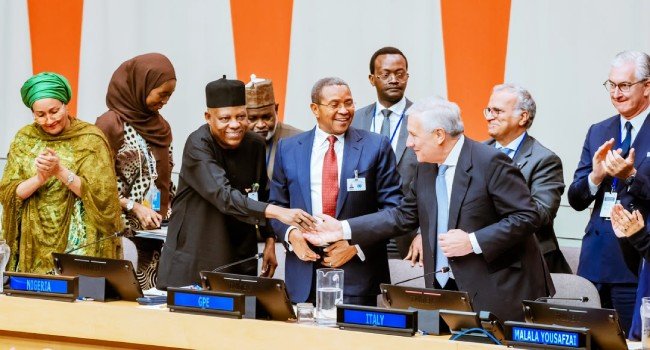
The campaign, known as Multiply Possibility, took centre stage on September 23, 2026, during a high-level event on the sidelines of the 81st United Nations General Assembly in New York. Nigeria and Italy are co-hosting the campaign with GPE.
The important point is that the $5 billion is not a direct $5 billion education grant to Nigeria. It is the global fundraising target for GPE. The campaign is designed to use international funding to unlock additional financing for education in participating countries.
What the $5 Billion Education Campaign Could Unlock
The scale of the campaign became clearer at the UNGA event. Global partners announced $2.1 billion in confirmed and anticipated sovereign donor pledges to GPE, alongside $1.4 billion in co-financing commitments from development finance institutions, philanthropies and private-sector partners.
GPE said partner countries also announced $471 billion in domestic education financing commitments, representing a planned 32% increase in spending by 2030.
For Nigeria, the focus is not only on getting more children into classrooms. The government has highlighted teacher capacity building, foundational learning, skills development and access to education as key priorities.
Vice President Kashim Shettima said Nigeria’s HOPE-EDU partnership with the World Bank and GPE is expected to reach about 29 million children and 500,000 teachers across the country.
Why Nigeria Is Taking a Bigger Role
Nigeria’s involvement reflects the country’s large and growing young population and the pressure to turn that population into a productive workforce.
At the UNGA event, Shettima said international funding should complement rather than replace domestic education spending. The government has also pointed to potential domestic sources, including legally cleared recovered funds, unclaimed dividends and dormant funds, for education financing.
The next challenge is implementation. Raising money is only one part of the problem. The funding must reach schools, teachers and students in ways that improve learning outcomes.
What Happens Next?
The campaign aims to support better education for hundreds of millions of children globally. GPE says a fully funded campaign could improve education quality for about 750 million children and young people in more than 90 countries.
For Nigeria, the real test will be whether international financing and domestic investment translate into better-equipped schools, stronger teacher capacity and measurable improvements in learning.
The September 23 event therefore marks less of an immediate cash injection and more of a push to change how education is financed over the coming years.
One thought on “Nigeria and Italy Back $5 Billion Global Education Financing Campaign at UNGA”