









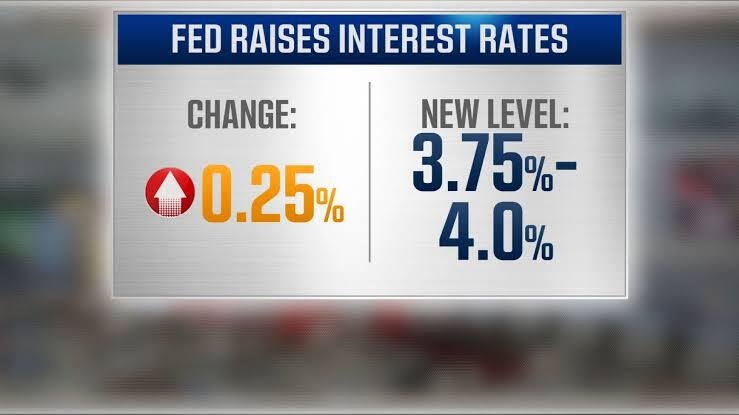
The US Federal Reserve has raised its benchmark interest rate for the first time in more than three years, taking the federal funds target range to 3.75% to 4% as policymakers respond to stubborn inflation. The decision came despite President Donald Trump’s repeated calls for lower interest rates.
At the same time, the US Treasury is expanding its bond buyback programme, creating an unusual combination in which the central bank is tightening financial conditions while the government works to improve liquidity in the Treasury market.
Fed Raises Interest Rates to 4 Percent
The Federal Open Market Committee voted unanimously to increase rates by 25 basis points. The Fed said inflation remains elevated and that the move is intended to support a faster return towards its 2% inflation target.
The September decision was the first Fed rate hike since July 2023 and the first increase under Chairman Kevin Warsh. The central bank also signalled that another increase could come before the end of 2026, with 16 of its 18 policymakers projecting at least one more hike.
The decision puts the Federal Reserve rate hike under Kevin Warsh at the centre of financial markets, particularly because inflation has remained under pressure from higher energy costs, tariffs and strong economic activity.
Trump and the Fed Take Different Positions
Trump has repeatedly argued that US interest rates should be much lower. On September 16, he again called for rates of 1% or below after the Fed announced its decision.
The disagreement highlights the continuing tension between the administration’s preference for cheaper borrowing and the Federal Reserve’s mandate to maintain price stability. Warsh has defended the central bank’s independence, while the latest decision was approved unanimously by the FOMC.
For households and businesses, higher rates can mean more expensive borrowing, while savers may benefit from higher returns on some interest-bearing products.
Treasury Expands Bond Buybacks
While the Fed is raising rates, the Treasury is taking a different approach in the government bond market.
The Treasury announced that it would at least double the maximum size of its liquidity-support buybacks for longer-dated Treasury securities, from $2 billion to at least $4 billion per operation. The expanded programme covers the 10-to-20-year and 20-to-30-year sectors and began on September 9.
These purchases are designed to improve trading conditions for older, less-liquid Treasury securities. They are not quantitative easing, because the Treasury is not creating money in the way the Federal Reserve does through monetary policy.
Why the Two Moves Matter
The combination of a Fed interest rate hike and larger US Treasury bond buybacks shows that Washington is dealing with two different financial pressures at once.
The Fed is focused on inflation, while the Treasury is focused on keeping the world’s largest government bond market functioning smoothly.
Markets are now watching whether inflation falls enough to stop further rate increases, and whether Treasury buybacks can improve liquidity without being mistaken for a broader stimulus programme.
The next major question is whether higher rates will slow economic activity enough to reduce inflation, or whether persistent energy and price pressures will force the Fed to keep tightening.