







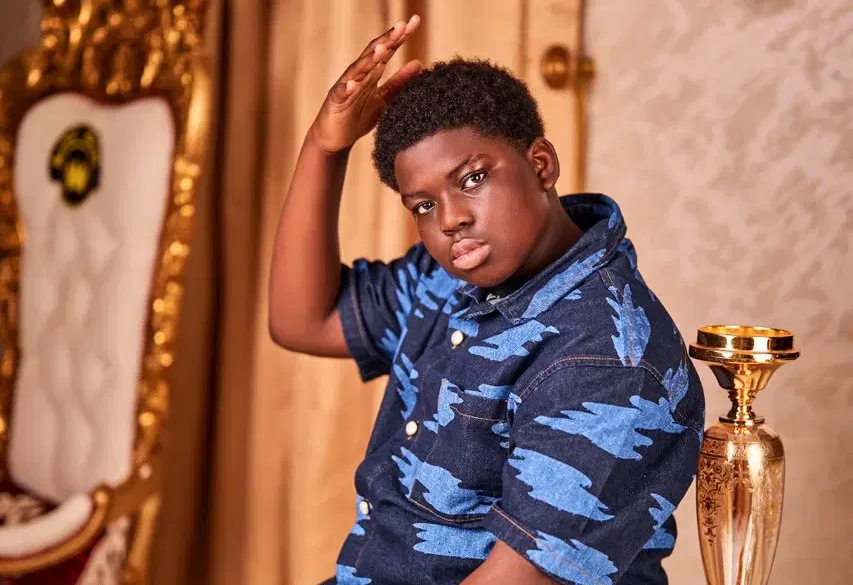
At just 13, Nigerian rapper Iceking Ochacho is already learning one of the hardest lessons in the music business: getting people to listen is one thing, but getting them to remember you is another.
The young artist, whose real name is Shedrack Mohammed Adah, recently celebrated his I’m Back EP by giving ₦20,000 to each of more than 100 fans who attended his album event in Nigeria. Videos from the event show fans receiving the cash as the teenager marked another step in his developing music career.
That puts the reported giveaway at more than ₦2 million if 100 fans received the full amount. But beyond the impressive figure, the gesture raises an interesting question for Nigeria’s music industry: can money create genuine fan loyalty, or can it only create attention?
Iceking Ochacho Is Already Building a Music Identity
Iceking Ochacho is not completely new to the spotlight. The young rapper has been releasing music and building his profile, with his I’m Back EP officially released in September 2025. The six-track project includes songs such as “Ochacho Money,” “Made for More,” “I Can,” “On My Way,” “Oh Papa” and “Oil on My Head.”
His music is also available across major streaming platforms, with Spotify currently listing I’m Back among his releases. He has also attracted attention through performances and collaborations, including his earlier work with established Nigerian artists.
That matters because the ₦20,000 giveaway is unlikely to be the only reason people know his name. It is part of a much bigger effort to build an identity around the young artist.
The Advantage of Having a Powerful Support System
Iceking is also the son of real estate businessman King Ochacho, giving him access to resources that many young artists can only dream about.
That support has already become part of the conversation around his career. But it also creates a difficult challenge for the teenager: proving that he can develop an audience because people genuinely connect with his music, rather than simply because he has the money and connections to create big moments.
The ₦20,000 giveaway is therefore a smart publicity moment, but it cannot substitute for good music. A fan may collect ₦20,000 today, but they will only stream a song tomorrow if they actually like it.
Can ₦20,000 Buy Fan Loyalty?
This is where Iceking’s move becomes more interesting. Giving fans money can create goodwill, generate social media content and encourage people to attend an event. It can also make a young artist’s launch feel bigger than it otherwise would.
But long-term fan loyalty is built differently. It comes from songs people repeatedly play, performances they remember and a personality they want to follow.
Iceking already has a head start because he is young enough to grow publicly alongside his audience. His challenge now is to turn the attention surrounding his family’s wealth and his unusual giveaways into something more lasting.
The Iceking Ochacho story may therefore be less about ₦20,000 and more about what happens after the money is gone.
If the music keeps people around, then the giveaway was simply a memorable bonus. If they disappear afterwards, it may prove that attention and loyalty are two very different things.

2 thoughts on “Iceking Ochacho’s ₦20,000 Giveaway Raises a Bigger Question About Building Young Music Fans”