










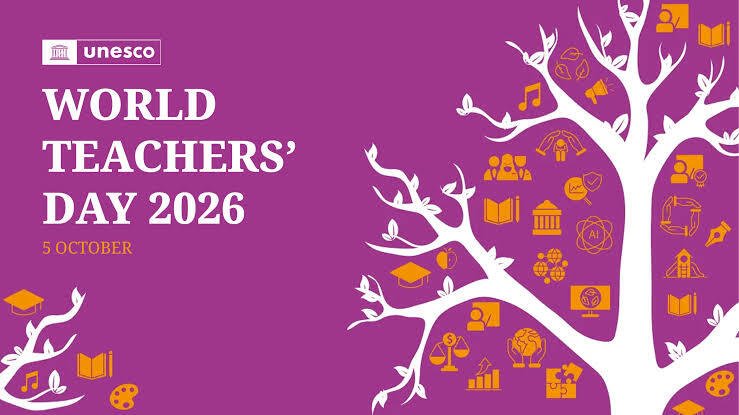
World Teachers’ Day 2026 is being marked around the world on October 5 with a message that goes beyond celebrating educators. Sixty years after the adoption of the landmark 1966 ILO/UNESCO Recommendation concerning the Status of Teachers, UNESCO is warning that the profession needs stronger support as countries face a global shortage of 44 million teachers by 2030.
The anniversary gives this year’s celebration a different meaning. The focus is not only on thanking teachers for their work, but also on whether governments are creating the conditions needed to attract, retain and support enough educators.
Why the 60th Anniversary Matters
The ILO UNESCO teacher recommendation 1966 established international standards covering teachers’ rights and responsibilities, professional preparation, recruitment, employment and working conditions.
World Teachers’ Day has been observed globally since 1994, with October 5 chosen to commemorate the adoption of the recommendation in 1966. The 2026 theme is “Standing with teachers: 60 years of protecting the profession, advancing its status and shaping our futures.”
Six decades later, UNESCO says teachers are facing new pressures from artificial intelligence and digital technology, climate change, migration, displacement and changing classroom needs. At the same time, concerns over salaries, workloads, professional autonomy and working conditions remain.
The 44 Million Teacher Problem
The biggest warning attached to World Teachers Day 2026 is the scale of the global shortage. UNESCO estimates that 44 million additional teachers are needed by 2030 to achieve universal primary and secondary education. Sub-Saharan Africa faces some of the most serious shortages, while other regions are also struggling to recruit and retain qualified educators.
This means celebrating teachers without addressing why people leave the profession could leave education systems facing an even bigger problem. UNESCO estimates that about $120 billion would be needed every year by 2030 to address the global teacher shortage.
Nigeria Joins the Global Celebration
In Nigeria, World Teachers’ Day has also brought renewed attention to teacher welfare and the role educators play in developing the country’s human capital.
Peter Obi praised Nigerian teachers on October 5, describing them as important to the quality of citizens and leaders the country produces. Edo State Governor Monday Okpebholo also praised teachers for their dedication and said his administration would continue to focus on their welfare and the education sector.
The Nigerian discussion reflects the wider global issue. Teachers are being asked to prepare children for a rapidly changing world, but education systems still have to deal with questions around pay, staffing, training and working conditions.
Beyond the Cakes and Tributes
Across social media, October 5 has brought the usual messages of appreciation, photos, gifts and personal stories about teachers who changed students’ lives.
But the World Teachers’ Day 60th anniversary comes with a much bigger challenge. If the world needs 44 million more teachers within four years, appreciation alone will not fill the classrooms.
The real test is whether governments can turn today’s recognition into better support, stronger professional standards and working conditions that make teaching a profession people can build their lives around.