








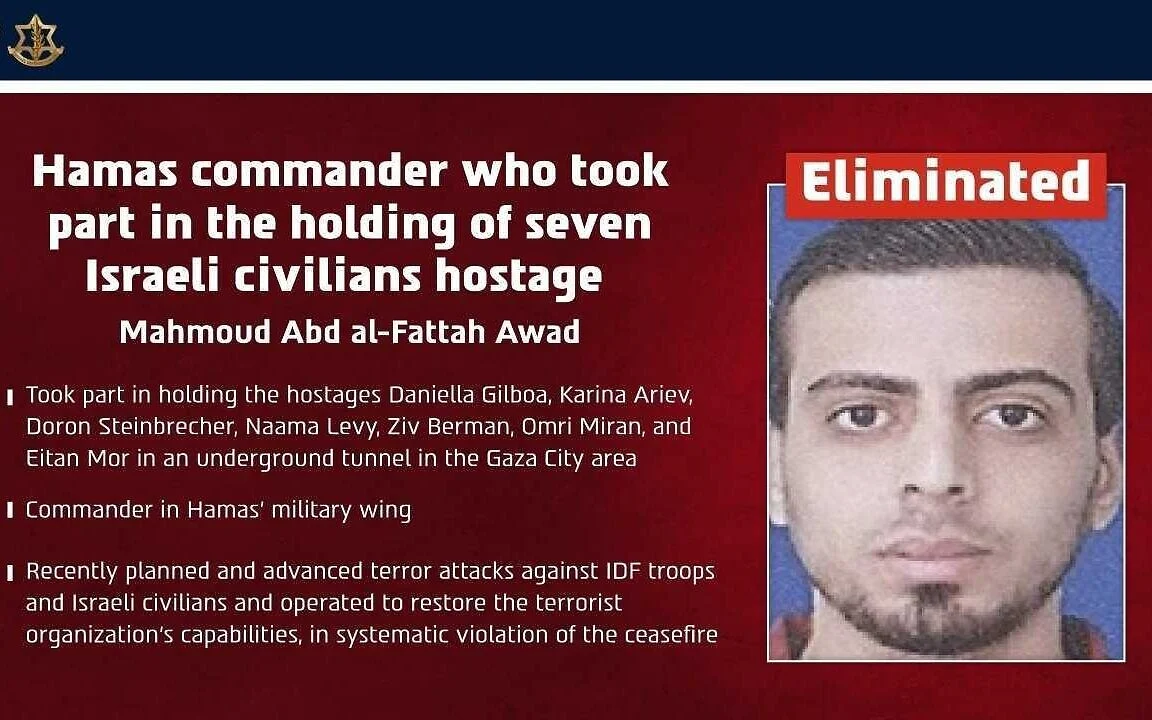
The Israeli military says it has killed Mahmoud Abd al-Fattah Awad, a Hamas military wing commander who was involved in holding seven Israeli hostages during the Gaza war. The strike, carried out in the Gaza City area over the weekend, has drawn attention because the target was reportedly connected directly to the captivity of several hostages, including Daniella Gilboa, Karina Ariev, Naama Levy and others.
The development comes alongside another Israeli operation targeting Hamas finance chief Muhammad Abu Alwan in Khan Younis. Taken together, the operations show that Israel is targeting both Hamas’s remaining military leadership and the financial structures it says are helping the group rebuild.
Commander Linked to Seven Hostages
According to the IDF, Awad was responsible for guarding seven Israeli hostages inside an underground tunnel in Gaza City during the conflict. The military says those held under his watch included Daniella Gilboa, Karina Ariev, Doron Steinbrecher, Naama Levy, Ziv Berman, Omri Miran and Eitan Mor.
The hostage connection gives the Hamas commander killed in Gaza operation a particular significance for Israel, where the fate of hostages has remained one of the central issues of the conflict.
The IDF also says Awad had recently been involved in planning attacks against Israeli civilians and troops and was helping Hamas restore its military capabilities. Israel described those activities as violations of the ceasefire and said the strike was intended to remove an immediate threat.
Israel Is Also Targeting Hamas’s Money
The second operation points to another part of the strategy. Israel says Muhammad Abu Alwan, Hamas’s finance department chief, was killed in an airstrike in Khan Younis on September 23. According to the IDF and Shin Bet, more than 1 billion shekels was transferred under his direction during the war to finance Hamas activities. Israeli officials also accused him of helping the organisation restore its capabilities during the ceasefire.
Israel says it is now focusing not only on individual commanders but also on money changers and other financial facilitators it believes can help Hamas rebuild. That makes the Abu Alwan operation part of a broader effort to restrict the group’s ability to recover militarily.
What the Strikes Could Mean for the Ceasefire
The timing is important because both operations come while Israeli forces remain deployed in Gaza under the ceasefire arrangement.
Israel says the strikes were necessary because the individuals targeted represented immediate threats or were helping Hamas rebuild. Hamas has not independently confirmed all of the Israeli military’s claims about the two men, and battlefield assessments are difficult to verify independently.
The immediate question is whether continued Israeli strikes against alleged ceasefire violations will remain limited to specific targets or lead to a wider deterioration in the truce.
For now, the Gaza ceasefire and Hamas rebuilding remain closely connected. Israel is signalling that a ceasefire will not prevent it from acting against what it considers immediate threats, while the deaths of figures linked to hostage captivity and Hamas’s finances could further shape the next stage of the conflict.


One thought on “IDF Says Hamas Commander Who Held Israeli Hostages Killed in Gaza Strike”