









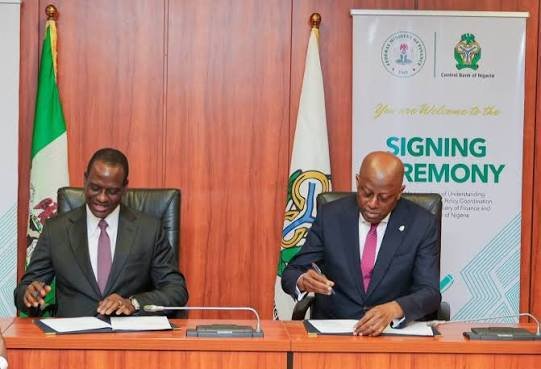
Nigeria’s economic managers have taken a step toward making fiscal and monetary policy work more closely together, with Finance Minister Taiwo Oyedele and Central Bank of Nigeria Governor Olayemi Cardoso signing a new Memorandum of Understanding on September 21, 2026.
The Nigeria fiscal-monetary policy coordination MoU creates a formal framework for regular consultation, information sharing and joint policy assessment between the Ministry of Finance and the CBN. The bigger goal is to reduce situations where government borrowing, spending and monetary policy work against each other.
Why the CBN and Finance Ministry Want Closer Coordination
Nigeria’s fiscal and monetary authorities have always had to deal with the same economic pressures, but they operate through different policy tools. Government spending, borrowing and taxation influence demand and liquidity, while the CBN manages monetary conditions, interest rates and financial stability.
The new framework is designed to make those decisions more coordinated. It will cover government cash management, debt issuance planning, liquidity forecasting, macroeconomic analysis and regular policy consultations.
Oyedele said the arrangement is intended to make coordination less dependent on the personalities occupying the two offices. In practical terms, the government wants the relationship to continue through established processes even when ministers and central bank officials change.
Inflation Is One of the Biggest Tests
The timing matters because the CBN is moving toward an inflation-targeting framework, making the relationship between government spending and monetary policy more important.
The Finance Ministry says inflation cannot be addressed through interest-rate decisions alone. Oyedele pointed to food supply, energy costs, logistics and imported costs as factors that also influence prices.
The MoU therefore includes the sharing of economic data and common macroeconomic assumptions. The authorities want better forecasts for inflation, liquidity, government financing and foreign exchange flows so that both sides can identify potential conflicts earlier.
The CBN Will Still Keep Its Independence
One important part of the agreement is that coordination does not mean the Finance Ministry will control monetary policy.
Oyedele stressed that the CBN’s operational independence remains intact. The purpose of the framework is to coordinate policies while allowing each institution to maintain its separate responsibilities.
This distinction will matter as Nigeria deals with inflation, government borrowing and liquidity. If government borrowing increases pressure on interest rates or liquidity, for example, better advance communication could allow both institutions to plan around the impact.
The Real Test Starts After the Signing
The MoU itself does not change food prices, interest rates or the exchange rate overnight. Its importance will depend on whether the new procedures actually change how economic decisions are made.
CBN Deputy Governor Sani Abdullahi said the framework will require timely information sharing, joint analysis, scenario planning and stress testing. He also noted that external shocks, including changes in oil prices and global shipping conditions, can affect government revenue, foreign exchange inflows and domestic prices at the same time.
That makes implementation the key issue to watch. If the new system produces more consistent forecasts and fewer policy conflicts, it could make Nigeria’s economic management more predictable. The government has also set a longer-term objective of bringing inflation sustainably into single digits, although the MoU itself does not guarantee that outcome.