








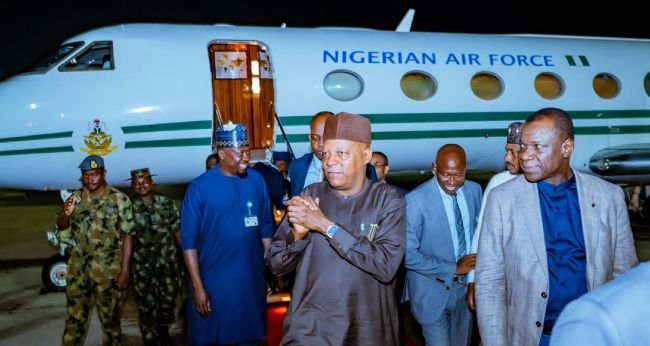
Vice President Kashim Shettima has returned to Nigeria after leading the country’s delegation to the 18th BRICS Summit in New Delhi, where Nigeria and India agreed to work towards restoring bilateral trade to nearly $15 billion.
The target follows a meeting between Shettima and Indian Prime Minister Narendra Modi on the sidelines of the summit. Modi also called for India to renew its purchases of Nigerian crude oil, making energy one of the clearest areas where both countries could quickly rebuild trade.
Nigeria and India recorded about $14.95 billion in bilateral trade in 2021/2022, but the figure fell to $7.13 billion in 2024/2025 as Indian purchases of Nigerian crude declined. Trade recovered to around $9 billion in 2025/2026.
Why India Wants Nigerian Crude Again
The renewed interest in Nigerian crude comes at an important time for India. Global energy markets are facing significant disruption, with crude prices recently rising above $100 per barrel amid the wider Middle East crisis.
For Nigeria, stronger Indian demand could provide another major market for crude exports while helping rebuild a trade relationship that has weakened in recent years.
But the opportunity is bigger than oil. Discussions between the two countries also covered trade and investment, defence, agriculture, healthcare, digital technology and energy. India’s experience with technology and its large young population was also highlighted during Nigeria’s BRICS engagement.
Can Nigeria Turn The Target into Real Trade?
The $15 billion target sounds significant, but the gap between the two countries’ previous peak and current trade shows that a crude deal alone may not be enough.
Nigeria would need to increase exports beyond raw commodities while attracting more Indian investment into manufacturing, pharmaceuticals, technology and other sectors. That could make the relationship more balanced and less dependent on oil.
The next test will therefore be whether the Nigeria-India $15 billion trade target produces actual contracts, investment and renewed crude purchases, rather than remaining a diplomatic ambition announced at a summit.