






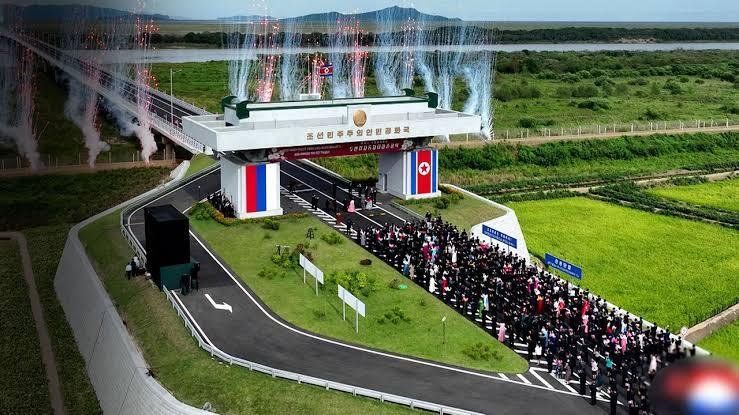
Russia and North Korea have opened their first road bridge across their shared border, creating a new transport link as the two countries deepen their strategic partnership.
The one-kilometre bridge crosses the Tumen River and connects Russia’s Khasan area with North Korea’s Rason region. The opening took place on September 7, with Russian Prime Minister Mikhail Mishustin and North Korean Premier Pak Thae-song joining the ceremony by video link.
But the Russia North Korea road bridge is significant for more than transportation. It comes as Moscow and Pyongyang have expanded military, economic and political cooperation, particularly since Russia’s war in Ukraine began.
A New Route for Russia-North Korea Trade
The bridge is expected to make movement between the two countries easier throughout the year. Russian officials said the crossing can handle up to 300 vehicles a day. Trucks have already begun using the route, while passenger traffic is expected to follow later this year. The bridge also connects to Russia’s wider road network and an international transport corridor linking Vladivostok with western Russia.
For North Korea, the route could provide another channel for trade and economic activity with Russia. Pyongyang still depends heavily on China for external trade. About 98% of North Korea’s external trade was with China in 2025, according to AP. The new bridge therefore gives North Korea another physical connection to a major partner at a time when its relationship with Moscow is becoming increasingly important.
Why the Bridge Matters Beyond Trade
The timing is what makes the first Russia North Korea road bridge particularly important. North Korea has supplied Russia with ammunition and troops connected to the war in Ukraine, while Moscow has strengthened military and economic cooperation with Pyongyang. The new road connection gives the countries another way to move goods and people across their border.
That has also raised concerns over whether the bridge could eventually be used to move military equipment or other goods in ways that are harder to monitor.
Experts cited by AP noted that road traffic can be more difficult for satellites and other intelligence systems to track than the existing railway route. However, there is no evidence that the bridge is currently being used to move prohibited military supplies.
What Comes Next
The two countries are presenting the project as a route to greater tourism, trade, economic cooperation and people-to-people exchanges. North Korean state media described the bridge as infrastructure that could help increase tourism and the movement of goods and people.
Its real importance will become clearer as traffic increases. For Moscow and Pyongyang, the bridge is another sign that their relationship is moving from political statements to physical infrastructure. With Russia and North Korea already expanding cooperation in other areas, the new crossing could become an important part of that growing partnership.