










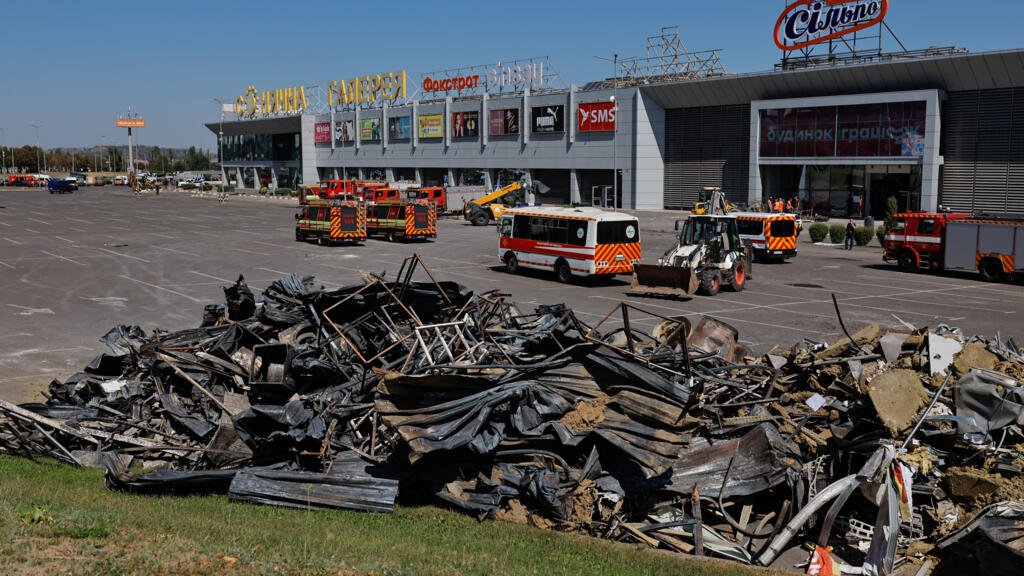
The war in Ukraine is once again forcing the world to confront a difficult question: should war ever reach places where ordinary people live, shop and go about their daily lives?
At least 15 people were killed and more than 130 injured after Russian drones struck a shopping centre in Kryvyi Rih, the hometown of Ukrainian President Volodymyr Zelenskyy. Children were among those injured, while rescue workers continued searching through the damage. The death toll was later reported at 16.
The Ukraine shopping mall strike has drawn international condemnation, but it also highlights something bigger than one strike. After more than four years of war, Ukrainian cities are increasingly becoming part of the battlefield, with civilians paying the price.
When the Battlefield Becomes a Shopping Mall
A shopping centre is not a military base. It is a place where people work, buy food, meet friends and take their children.
That is why attacks on residential areas and civilian infrastructure in Ukraine are so disturbing. Recent Russian attacks have also hit apartment buildings, a children’s hospital and a Red Cross facility in Kyiv. The European Union has repeatedly condemned attacks on densely populated areas and civilian infrastructure.
The latest strike was particularly alarming because Ukrainian officials described it as a possible “double-tap” attack. According to the Ukrainian authorities, a second drone hit the area after the first strike, when emergency responders had arrived to help victims.
If confirmed, that would make an already devastating attack even more serious because emergency workers themselves would have been placed in danger.
Does War Have Rules?
Wars are fought between armies, but civilians are protected under international humanitarian law. The basic principle is that military forces must distinguish between military targets and civilians and civilian objects.
That does not mean civilian buildings can never be damaged during war. A civilian structure could be affected if there is a legitimate military target nearby. But deliberately targeting civilians or civilian objects is prohibited, as are attacks that fail to distinguish between military and civilian targets.
Russia has denied deliberately targeting civilians and says its strikes are aimed at military or strategic targets. Ukraine has also carried out long-range strikes inside Russia, including attacks on oil and logistics infrastructure, while Moscow says those attacks are evidence of Ukraine escalating the conflict.
That is what makes accountability difficult. Each side presents its attacks as military operations while accusing the other of crossing the line.
What Happens When Civilians Become Part of the Pressure?
The human cost is becoming harder to ignore. The United Nations reported that civilian casualties in Ukraine rose sharply during the first half of 2026, while July recorded one of the highest civilian death tolls of the war.
The danger is that attacks on cities can become more than attempts to destroy infrastructure. They can create fear, force people from their homes and put pressure on governments through the suffering of their populations.
That is why the question is not simply whether Russia or Ukraine can hit another military target. It is whether a war that has already lasted years can continue to expand into homes, hospitals, shopping centres and neighbourhoods without civilians becoming the real battlefield.
War may be fought for political and military objectives, but civilians should never become the price of achieving them.



2 thoughts on “Should War Reach Residential Places? Ukraine Shopping Mall Strike Raises a Bigger Question”