






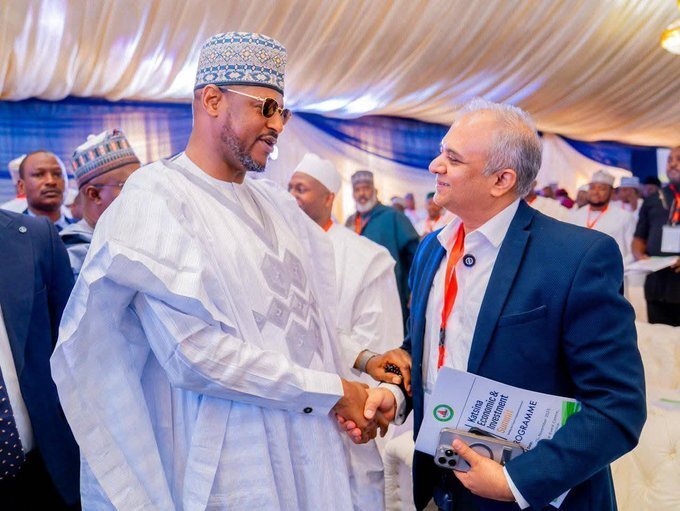
Katsina State has attracted more than ₦489.4 billion in investment pledges across agriculture, manufacturing, energy, technology and enterprise development, giving Governor Dikko Umar Radda’s administration a major opportunity to reposition the state as a stronger business destination in northern Nigeria.
The commitments came from the state’s 2025 Economic and Investment Summit, which brought together investors, businesses, development partners and government officials. But there is an important distinction between investment pledged and investment delivered.
That could determine whether this becomes a major economic success story or simply another impressive government announcement.
Security Was the First Investment Pitch
Katsina’s strategy is interesting because the state did not present investment as the starting point. It presented security as the starting point.
When the Radda administration came into office, insecurity had affected large parts of the state, restricting access to farms and forcing some rural markets to close. The government says it has since deployed more than 2,500 Community Watch Corps members and activated more than 9,700 community-based security committee members.
The argument to investors is straightforward: businesses cannot operate where farmers cannot reach their land, goods cannot move safely and markets cannot function. The reported reopening of rural markets and farmland therefore matters just as much as the investment pledges themselves.
Agriculture Could Be the Biggest Opportunity
Katsina already has a major agricultural base, but the state wants to move beyond simply producing raw crops.
The summit focused on areas including mechanisation, agricultural finance, food processing, livestock and export markets. Investors also announced projects involving poultry, soya processing and livestock processing.
That shift could have a much bigger impact on ordinary residents. A factory processing crops locally can create jobs, provide markets for farmers and generate additional businesses around transportation, storage and packaging. That is very different from simply exporting raw agricultural products.
The ₦489bn Figure Needs to Become Real
This is where the pressure on the state government begins. The reported commitments include major projects such as KUBEK’s proposed $150 million industrial partnership, Torq’s $80 million project and ABIS Group’s $50 million investment.
But a pledge is not a factory. It is not a completed farm, a processing plant or a new job. Katsina will need to make it easy for these investors to move from announcements to construction, production and employment.
The state’s recent reforms, including digitalised government processes, the Treasury Single Account and efforts to improve land administration, are designed to reduce some of those barriers.
What This Could Mean for Katsina
If the projects materialise, the effect could extend far beyond government revenue. More investment could mean jobs for young people, new markets for farmers, stronger local businesses and greater economic activity outside Katsina city.
But residents should judge the success of the summit by what happens next. The real headline will not be ₦489.4 billion pledged. It will be how much of that money eventually becomes factories, farms, businesses, infrastructure and jobs.