










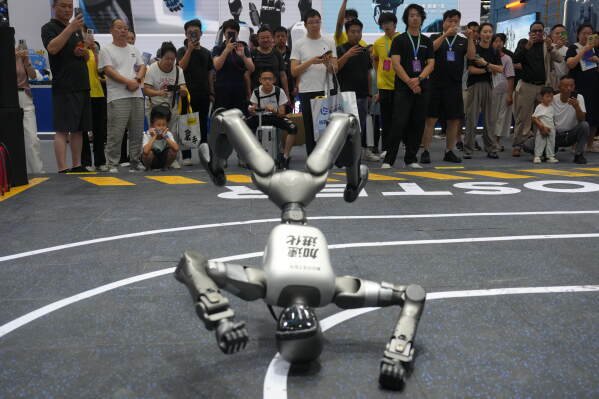
The future of humanoid robots looked impressive at the 2026 World Robot Conference in Beijing. Robots danced, boxed, played table tennis and demonstrated tasks designed to show how machines could eventually work alongside humans.
But some of the most memorable moments came when the robots simply stopped working properly. Several humanoid robots reportedly malfunctioned during demonstrations and rehearsals on August 19. One appeared to convulse on the floor, another moved violently after losing control, while a third crashed into a cushion during a game rehearsal and reportedly broke at the waist, producing sparks.
The incidents are embarrassing, but they also highlight a much bigger problem for the rapidly growing robotics industry.
Looking Impressive Is Not the Same as Being Ready
China’s robotics industry is moving at remarkable speed. More than 300 companies are taking part in this year’s conference, with over 2,000 exhibits and more than 150 new products being launched.
The ambition is no longer simply to build robots that can perform impressive tricks. Companies want humanoids that can sort packages, work in factories, handle household tasks and eventually operate in ordinary homes and businesses.
That changes the standard. A robot falling over during a demonstration is one thing. A robot losing control while carrying a heavy object, working around children or operating beside factory workers is something completely different.
The Biggest Challenge May Be Reliability
The glitches raise questions about some of the biggest challenges facing humanoid robots: balance, movement control, software reliability and emergency shutdown systems.
The industry is already trying to move beyond staged demonstrations. The upcoming World Humanoid Robot Games, running from August 22 to 26, will include tasks designed to test robots in situations that resemble real work rather than just athletic performances.
That could provide a much better test of how far the technology has really come. The question is no longer simply, “Can a robot walk?”
It is “Can it keep working safely and consistently when something unexpected happens?”
Investors Are Watching Too
There is serious money behind the current excitement. Unitree, one of China’s leading humanoid robot manufacturers, made its Shanghai stock market debut alongside the conference, with its shares surging dramatically. The company’s IPO was reportedly more than 8,000 times oversubscribed by retail investors.
That enthusiasm creates pressure on manufacturers to prove that humanoid robots can become profitable products rather than expensive technology demonstrations.
Industry leaders themselves are sounding cautious. Unitree CEO Wang Xingxing said robots could eventually experience a “ChatGPT moment”, but estimated that major software breakthroughs could still be two to ten years away.
The Glitches May Actually Be Useful
The failures should not be seen as proof that humanoid robots are a failure. In fact, public demonstrations can expose weaknesses that engineers need to fix. The real concern would be if the industry focused more on viral videos than reliability.
For now, Beijing’s robot conference is showing both sides of the story. The machines are becoming more capable, but they are still far from behaving like dependable human workers.