









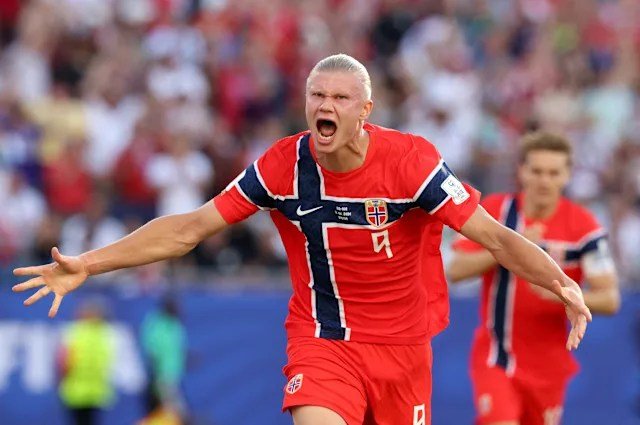
Erling Haaland has unexpectedly become part of a major drug seizure in Ecuador — not because of anything he did, but because traffickers allegedly used the Manchester City and Norway star’s image to mark packages in a shipment of cocaine.
Ecuadorian police seized 469 kilograms of cocaine packed into 370 packages after stopping a truck near the Colombian border following an anonymous tip. The drugs were concealed inside a false compartment, and the packages carried stickers featuring Haaland. A Colombian woman was arrested in connection with the shipment. Authorities valued the haul at nearly $20 million on the European market.
Haaland has no reported connection to the shipment and is not accused of any wrongdoing. The bizarre branding is actually part of a wider phenomenon. Drug-trafficking organisations have previously used images and names of footballers and other celebrities on packages as a way of identifying shipments, destinations or networks. Lionel Messi’s image has also reportedly appeared on seized drug packages. Police have not publicly explained exactly what the Haaland markings meant in this particular case.
That makes the incident more significant than the memes it has generated online. Criminal organisations are operating in a world where celebrity recognition is almost universal. A footballer’s face can be instantly recognised in countries thousands of kilometres away from where the drugs originate. For trafficking networks, that creates an unusual visual language for identifying cargo without necessarily putting an obvious name or label on it.
And Ecuador is not a random location for such a seizure. The country sits between Colombia and Peru, two major cocaine-producing countries, and has become an important transit point for cocaine moving towards international markets. Ecuadorian authorities said they seized 80 tonnes of drugs during the first half of 2026 alone, following 215 tonnes in 2025.
The seizure therefore highlights the enormous scale of the trafficking infrastructure operating through the region. For Haaland, however, there is little more to the story than an unfortunate association created by criminals. His image appearing on a package does not indicate endorsement, involvement or knowledge.
The stranger part is what it says about modern criminal branding. Football stars have become so globally recognisable that their identities can apparently become useful symbols even inside criminal supply chains.
Haaland has spent years building a global brand. He probably never imagined criminals would find a use for it.